







Features:
-
Category:
-
Posted at:
-
Author:
- Stephanie Hesters
-
BAUNAT Antwerp
-


-
Reading time:8 minutes
In this article:
How is gold formed? A journey from stars to Earth
Gold’s journey to Earth is nothing short of cosmic. How is gold formed? This precious metal was created in the universe’s most dramatic events — neutron star collisions and supernova explosions — that scattered gold particles across the cosmos. These particles eventually became part of the swirling mass that would form our planet. Today, gold’s rarity, beauty, and storied origins make it one of Earth’s most coveted materials, cherished in jewellery and prized for its timeless allure. In this article, we’ll explore gold’s formation, where it can be found, and how it has been mined and refined throughout history.
Read summary
How is gold formed in the universe and what makes it so precious?
Gold's journey begins in the cosmos through spectacular events like neutron star collisions and supernova explosions. Only stars at least eight times larger than our sun can generate the extreme conditions needed to create gold atoms. When these stars die in violent explosions, they scatter gold particles across space, some of which eventually became part of Earth as our solar system formed.
Today, this precious metal can be found deep within the Earth's crust in veins, in riverbed sediments, and particularly in regions with seismic or volcanic activity. Countries like Australia, China, Russia, and South Africa are known for their significant gold reserves.
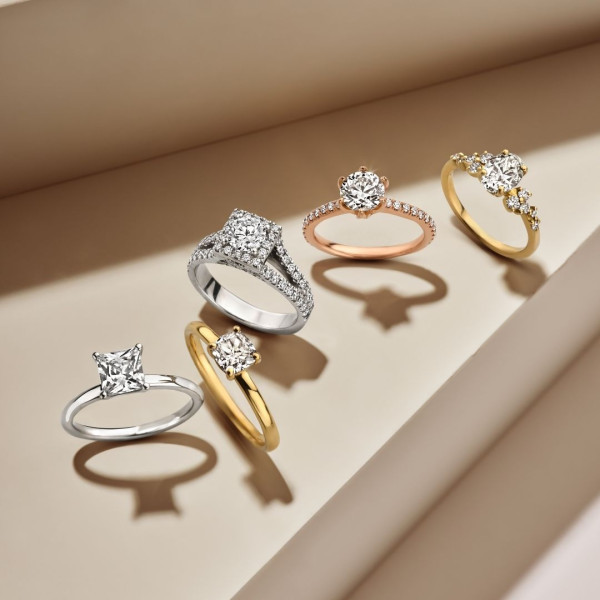
Gold's enduring value comes from both its rarity and remarkable properties. Its malleability allows jewelers to create intricate designs while its resistance to tarnish ensures lasting beauty. From traditional yellow gold to sophisticated white gold and romantic rose gold, its versatility continues to make it a cherished material for fine jewelry.
5 Questions to Find Her Perfect Engagement Ring
Are you planning to propose? Finding the right engagement ring is a defining step. Every ring is handcrafted in Antwerp from the finest materials by skilled artisans. Discover what engagement ring fits her personality.
Most viewed diamond jewels
-
![1.00Ct halo ring in white gold with oval diamond]() Bestseller1.00Ct halo ring in white gold with oval diamondFrom € 5.578,10 (incl. 21% VAT)
Bestseller1.00Ct halo ring in white gold with oval diamondFrom € 5.578,10 (incl. 21% VAT) -
![1.00 carat solitaire cluster ring in white gold with marquise diamond]() BestsellerNew1.00 carat solitaire cluster ring in white gold with marquise diamondFrom € 4.622,20 (incl. 21% VAT)
BestsellerNew1.00 carat solitaire cluster ring in white gold with marquise diamondFrom € 4.622,20 (incl. 21% VAT) -
![0.95 carat diamond rose design ring in white gold]() NewPrincess Delphine0.95 carat diamond rose design ring in white goldFrom € 16.831,10 (incl. 21% VAT)
NewPrincess Delphine0.95 carat diamond rose design ring in white goldFrom € 16.831,10 (incl. 21% VAT) -
![1.00 carat solitaire ring with an asscher cut diamond in white gold]() Bestseller1.00 carat solitaire ring with an asscher cut diamond in white goldFrom € 4.936,80 (incl. 21% VAT)
Bestseller1.00 carat solitaire ring with an asscher cut diamond in white goldFrom € 4.936,80 (incl. 21% VAT) -
![1.00 carat solitaire ring with a cushion diamond and hidden halo in white gold]() BestsellerNew1.00 carat solitaire ring with a cushion diamond and hidden halo in white goldFrom € 4.210,80 (incl. 21% VAT)
BestsellerNew1.00 carat solitaire ring with a cushion diamond and hidden halo in white goldFrom € 4.210,80 (incl. 21% VAT)


The origins of gold: in the heart of dying stars
Gold is as ancient as the celestial bodies themselves, yet its formation requires the fiery crucible of a star's core. Only stars with a mass exceeding eight times that of our sun can muster the force for the fusion reactions necessary to create gold. Upon their explosive demise, these stars cast their treasure into the universe, where it drifted until becoming part of the proto-planetary disk surrounding our nascent sun. Thus, every piece of gold we cherish on Earth today was forged in the heart of a dying star.

Where can gold be found?
Regions prone to seismic or volcanic activity often harbour rich deposits of gold. During an earthquake, the sudden release of pressure can cause water within the rock to vaporise instantly, precipitating dissolved minerals such as gold. This process gradually forms gold veins, though such geological wonders can take countless millennia to mature.
While gold can be discovered in small quantities worldwide, true bounty is found in select locales. North America, Canada, Australia, China, Russia, and South Africa are renowned for their abundant gold reserves, yielding massive nuggets weighing up to 10 kilograms.

How is gold extracted?
Gold mining, the traditional way
Traditionally, gold is extracted through mining operations that tunnel deep into the Earth to access rich veins. Once extracted, the raw gold undergoes a refinement process to remove impurities and reveal its lustrous sheen.

Gold panning for riverine environments
The importance of ethical sourcing
Moreover, the importance of ethical sourcing cannot be overstated. As consumers, we have the power to choose gold that is mined responsibly, ensuring that the rights of workers are protected and that environmental impacts are minimised. Supporting ethically sourced gold contributes to a more sustainable and equitable industry, allowing us to enjoy its beauty with a clear conscience.

The applications of gold in modern jewellery
Multiple varieties of gold
White gold, a modern alternative, is prized for its sleek, sophisticated allure. Created by alloying gold with metals like palladium or nickel, and often coated with rhodium, white gold presents a lustrous, silver-like sheen that complements today's minimalistic aesthetics.
Meanwhile, red gold is cherished for its romantic, subtle blushing tones.
Experience the exquisite craftsmanship of gold jewellery
Learn more about precious metals
- Precious metals: what types are there?
- What is white gold and how is it different?
- How do I tell the difference between white gold and platinum?
- What is rose gold and what is its charm?
- What is red gold and why would I choose it?
- What is the difference between red gold and rose gold?
- Yellow gold: where does our gold come from?
- Types of gold and their composition
-
Stephanie Hesters
-
BAUNAT Antwerp
-
-
As the Head of Diamond Buying at BAUNAT, Stephanie has an extensive knowledge of the diamond and the evolution of diamond prices. Thanks to her broad product knowledge gained throughout her years at BAUNAT and the Diamond Foundation Course by De Beers, Stephanie advises our customers interested in the investment side of diamonds to optimize every investment. To support her skills she has a bachelor’s degree in Business Management together with her master’s in Communication.
About Stephanie Hesters (also known as Stephanie Lasters)
Stephanie Hesters, sometimes listed online as Stephanie Lasters, is Head of Diamond Buying at BAUNAT. She manages diamond sourcing and valuation, advises clients on market trends and pricing, and helps those looking for investment-grade stones. She completed the Diamond Foundation Course by De Beers and holds a bachelor’s degree in Business Management and a master’s in Communication.
Selected projects & collaborations
• Eternal Bloom Collection with Princess Delphine of Saxe-Coburg (2026), curator and project lead - guided creative direction and diamond selection for an exclusive collection that blends classical motifs with contemporary craftsmanship.
• Investment Diamonds Advisory Series (2024), author and presenter - developed client-facing guides and presentations on diamond valuation and market dynamics for private buyers and collectors.
• BAUNAT Editorial Features and Product Launches (2022–2025), contributor - worked with design and marketing teams to shape product narratives and ensure technical accuracy in launch materials and editorial content.
As the Head of Diamond Buying at BAUNAT, Stephanie has an extensive knowledge of the diamond and the evolution of diamond prices. Thanks to her broad product knowledge gained throughout her years at BAUNAT and the Diamond Foundation Course by De Beers, Stephanie advises our customers interested in the investment side of diamonds to optimize every investment. To support her skills she has a bachelor’s degree in Business Management together with her master’s in Communication.
About Stephanie Hesters (also known as Stephanie Lasters)
Stephanie Hesters, sometimes listed online as Stephanie Lasters, is Head of Diamond Buying at BAUNAT. She manages diamond sourcing and valuation, advises clients on market trends and pricing, and helps those looking for investment-grade stones. She completed the Diamond Foundation Course by De Beers and holds a bachelor’s degree in Business Management and a master’s in Communication.
Selected projects & collaborations
• Eternal Bloom Collection with Princess Delphine of Saxe-Coburg (2026), curator and project lead - guided creative direction and diamond selection for an exclusive collection that blends classical motifs with contemporary craftsmanship.
• Investment Diamonds Advisory Series (2024), author and presenter - developed client-facing guides and presentations on diamond valuation and market dynamics for private buyers and collectors.
• BAUNAT Editorial Features and Product Launches (2022–2025), contributor - worked with design and marketing teams to shape product narratives and ensure technical accuracy in launch materials and editorial content.