







Features:
-
Category:
-
Posted at:
-
Author:
- An Van Puyvelde
-
An Van Puyvelde - Order & Administration Manager
-


-
Reading time:11 minutes
In this article:
How to choose an engagement ring?
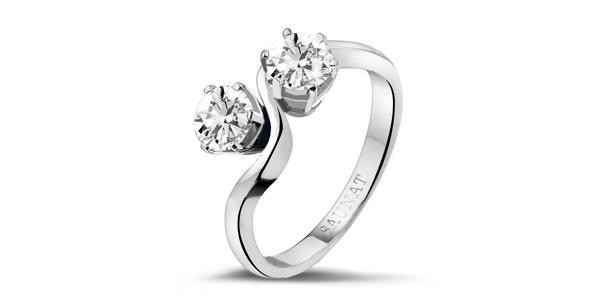
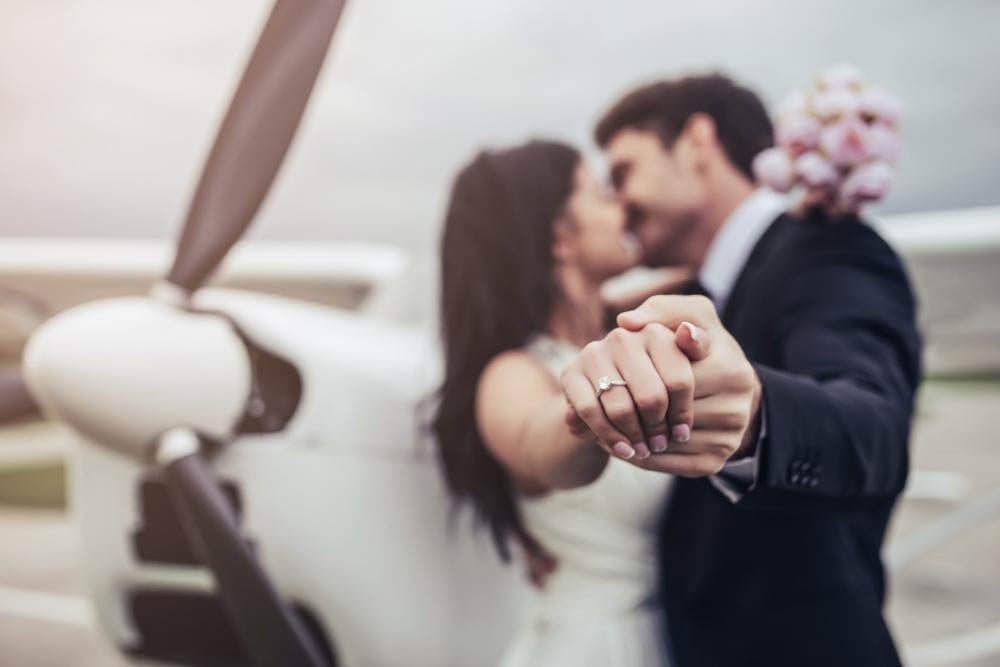
An engagement ring is a unique gift that one offers to his beloved. It proves, and more precisely, it is the evidence of a commitment to love of a man for his chosen one. There is a wide range of engagement rings on the market, making that people often do not know what to choose for their fiancée. Here you can find a guide to choosing an engagement ring. Which golden ring wins your heart?
Read summary
How can you select the perfect engagement ring for your special moment?
Choosing an engagement ring is a significant decision that requires careful consideration of your partner's style preferences while maintaining the element of surprise. While the traditional solitaire diamond ring remains the most popular choice, modern options include pavé settings, floral designs, and rings featuring colored diamonds or other precious gemstones like rubies, emeralds, and sapphires.
The metal choice is equally important - whether yellow gold, white gold, or silver - and should align with your partner's usual jewelry preferences. The standard for engagement rings is typically 18kt gold, though this can vary based on budget and taste. For those seeking a personal touch, consider custom engravings of initials or meaningful words.
To ensure the perfect fit without revealing your plans, discreetly borrow one of your partner's existing rings to determine the correct size at a jeweler. Remember, this ring symbolizes your eternal commitment, so it should reflect both your love and your partner's personal style.
5 Questions to Find Her Perfect Engagement Ring
Are you planning to propose? Finding the right engagement ring is a defining step. Every ring is handcrafted in Antwerp from the finest materials by skilled artisans. Discover what engagement ring fits her personality.
Most viewed diamond jewels
-
![1.00 carat solitaire cluster ring in white gold with marquise diamond]() BestsellerNew1.00 carat solitaire cluster ring in white gold with marquise diamondFrom € 4.622,20 (incl. 21% VAT)
BestsellerNew1.00 carat solitaire cluster ring in white gold with marquise diamondFrom € 4.622,20 (incl. 21% VAT) -
![1.00 carat solitaire cluster ring in white gold with a round diamond]() Bestseller1.00 carat solitaire cluster ring in white gold with a round diamondFrom € 4.343,90 (incl. 21% VAT)
Bestseller1.00 carat solitaire cluster ring in white gold with a round diamondFrom € 4.343,90 (incl. 21% VAT) -
![1.00 carat solitaire ring with an asscher cut diamond in white gold]() Bestseller1.00 carat solitaire ring with an asscher cut diamond in white goldFrom € 4.936,80 (incl. 21% VAT)
Bestseller1.00 carat solitaire ring with an asscher cut diamond in white goldFrom € 4.936,80 (incl. 21% VAT) -
![1.00 carat solitaire ring with a cushion diamond and hidden halo in white gold]() BestsellerNew1.00 carat solitaire ring with a cushion diamond and hidden halo in white goldFrom € 4.210,80 (incl. 21% VAT)
BestsellerNew1.00 carat solitaire ring with a cushion diamond and hidden halo in white goldFrom € 4.210,80 (incl. 21% VAT) -
![1.00 carat solitaire cluster ring in white gold with oval diamond]() BestsellerNew1.00 carat solitaire cluster ring in white gold with oval diamondFrom € 4.827,90 (incl. 21% VAT)
BestsellerNew1.00 carat solitaire cluster ring in white gold with oval diamondFrom € 4.827,90 (incl. 21% VAT)



Which kind of ring?
Of course, your fiancée should under no circumstances know that you will be offering her an engagement ring. An engagement is generally done in secret, to make the surprising effect for your belowed even bigger. Therefore it is essential to know her taste in terms of rings , because she will have to wear it her whole life.
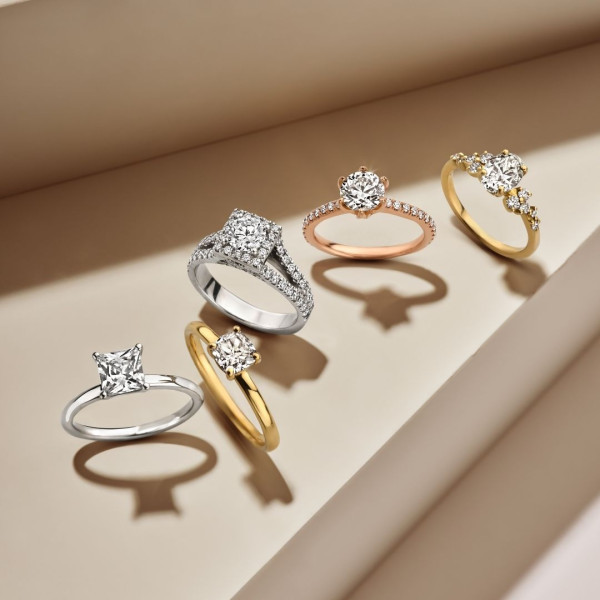
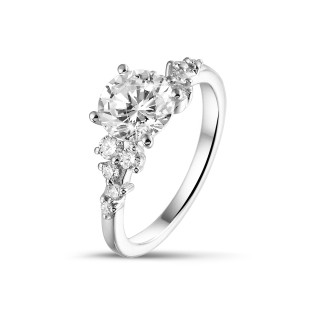
With jewelery designers, there is mostly a lot of choice in order to to meet the personality of each woman. Traditionally, the most popular model is the solitaire ring, this is a simple ring with a single diamond. There is also the solitaire ring with pavé that has the same principle, but with small diamonds on the side of the ring next to the central diamond.
For women who prefer fantasy, there are engagement rings in the shape of a flower, or colored models that bring together different metals and different colored stones such as pink, green or blue diamonds.
Elegant women are more likely to prefer engagement rings in a contemporary style with clean or geometric lines. You can also opt for vintage or romantic designs that are very feminine.
Those who love personalised jewellery can go for an expressive design. For example, engrave his initials in the ring, or a word engraved like 'yes' or 'love' can be both original and endearing.
How to buy: size, timeline and protections
Measure discreetly
Borrow one of her rings that she wears on the intended finger and measure the internal diameter in millimetres across the centre. Give that measurement to a jeweler for conversion to the correct ring size. If you cannot access a ring, trace the inner circumference on paper and compare the tracing to a jeweler’s size chart. When unsure, choose a slightly larger size rather than smaller; resizing down is generally easier than up.
If you are unsure
Consider a dummy ring for the proposal and confirm the final ring afterwards. A simple, stylish band can be presented on the day and replaced once the correct size is confirmed. Many couples prefer this approach to keep the moment while avoiding guesswork.
Timeline and bespoke work
Bespoke and made-to-order rings need planning. Discuss expected lead times with the jeweler when you start the design, and confirm whether there are milestones such as design approval. Allow flexibility: bespoke timelines vary by complexity and stone availability, and a jeweler can explain the stages without fixed dates.
Final practical tips
Keep proof of purchase and any certificates together in a safe place. If resizing is needed later, most jewellers offer resizing services; clarify any guarantees or exchange policies before purchase. If you plan to engrave the ring, wait until sizing is confirmed so the inscription isn’t compromised.
Which stone to prefer ?
According to the the French tradition, a man must offer his future wife a diamond ring as a sign of his purity and eternal love. Nevertheless, there are other gems than diamonds like ruby which symbolizes passionate love, the emerald that stands for true and fruitful love or sapphire which means you'll always be loyal and honest with her.
Ring shapes and settings - how to pick the look
Choosing the cut and the setting defines the ring’s overall character. Below are common shapes and the principal settings, with practical notes on how each sits on the hand, how large the centre stone appears, and any durability or maintenance points to consider.
Round brilliant
Visual: a perfectly symmetrical, classic round cut that returns light strongly. Who it flatters: works well on most hands and finger lengths because of its symmetry. Perceived size: efficient light return makes round stones look lively; a well-cut round often appears larger than other shapes of the same weight. Durability/maintenance: without sharp points, the round is among the most robust shapes and is straightforward to clean or re-set.
Oval
Visual: an elongated rounded shape that looks elegant and modern. Who it flatters: elongates the finger, which suits shorter fingers or wider hands. Perceived size: the stretched outline makes an oval appear larger across the finger than a round of equal carat. Durability/maintenance: less prone to chipping than pointed shapes, though the ends’ prongs should be checked regularly.
Cushion
Visual: a soft square or rectangle with rounded corners and large facets that give a vintage feel. Who it flatters: complements many hand types; its softer corners suit romantic or antique-inspired styles. Perceived size: appears slightly less large than an oval for the same weight because of a deeper pavilion, but its broad table still reads substantial. Durability/maintenance: rounded corners are forgiving; pavé or halo settings will need occasional inspection to keep small stones secure.
Pear
Visual: a teardrop combining rounded and pointed ends for a distinctive profile. Who it flatters: elongates the finger and suits slim fingers; the point can face toward or away from the wearer for different effects. Perceived size: the tapered shape can make the stone look longer. Durability/maintenance: the pointed tip is the vulnerable area; use a protective prong or partial bezel at the point and have it checked periodically.
Princess
Visual: a modern square with crisp corners and strong brilliance. Who it flatters: good for slender fingers and contemporary tastes; the square outline gives a bold silhouette. Perceived size: the face-up area is efficient, so a princess can appear sizeable for its carat weight. Durability/maintenance: sharp corners need protective settings or firm prongs to reduce the risk of chipping.
Emerald
Visual: a rectangular step-cut with long facets and a hall-of-mirrors effect rather than intense sparkle. Who it flatters: elegant on slim, long fingers and well suited to minimalist or art-deco styling. Perceived size: the broad, open surface reads large, but lower brilliance makes inclusions more visible. Durability/maintenance: large facets show wear and inclusions clearly; higher clarity is advisable and a bezel or strong prong helps protect the corners.
Marquise
Visual: an elongated shape with pointed ends and a football-like profile. Who it flatters: lengthens the finger and provides strong visual impact on wider hands. Perceived size: one of the most efficient shapes for face-up size, often appearing larger than its weight suggests. Durability/maintenance: both points are vulnerable; protective prongs or end bezels are recommended and routine inspections are prudent.
Principal settings
Visual: a single centre stone on a plain band, timeless and focused on the gem. Effect on look: puts full emphasis on the stone and suits many cuts, particularly round and princess. Practical note: easiest to clean and maintain; check the prongs regularly to keep the gem secure.
Visual: a ring of smaller stones encircling the centre stone, which adds brilliance and apparent size. Effect on look: makes the centre stone read larger and more ornate; pairs especially well with round, cushion and oval cuts. Practical note: halo settings collect more dirt and need careful cleaning; check pavé stones to prevent loosening.
Visual: the band is set with tiny diamonds to create continuous sparkle. Effect on look: adds glitter without changing the centre profile; ideal for adding luxury to slender bands. Practical note: small stones require delicate cleaning and occasional tightening, especially if the wearer has an active lifestyle.
Bezel
Visual: the centre stone is rimmed by metal for a smooth outline. Effect on look: modern and secure, it can slightly reduce visible sparkle but increases protection. Practical note: excellent for everyday wear and for pointed shapes when the bezel is designed to shield vulnerable tips.
Three-stone
Visual: a central stone flanked by two smaller side stones for balance and added presence. Effect on look: introduces more visual weight and meaning, and allows contrast in shape or colour. Practical note: side stones add joins that should be inspected; choose settings that protect the side stones’ corners.
Choosing a combination
Match shape and setting to lifestyle and taste. If daily wear and low maintenance matter, favour durable shapes and protective settings such as a bezel or well-built prongs. If maximum sparkle and perceived size are priorities, a round or cushion in a halo or pavé setting will deliver strong visual impact. For any pointed cut, request reinforcement at the tips. For more on how proportions and polish influence light performance, Baunat’s diamond hub explains cut and polish considerations in detail.
A ring in silver or gold: which one is a good choice?
Here too, it is a matter of taste. Does she usually wear classic metals such as yellow gold, or does she prefer a little more discrete jewellery in silver or white gold. It is in function of these preferences that you orient your choice. You only need to know that the standard for engagement rings normally is 18Kt, but ultimately you will choose the ring that suits your budget and taste the most.
One last tip: if you do not know the ringsize of your beloved, you can just take one of her rings to the jeweler who will determine the correct size.
-
An Van Puyvelde
-
An Van Puyvelde - Order & Administration Manager
-
-
An supervises BAUNAT’s order processing and logistics, working closely with the internal order team to ensure a seamless customer experience. She plays a key role in coordinating production timelines and maintaining clear communication with clients throughout the entire process. With a strong focus on precision and reliability, An is dedicated to delivering each piece on time while keeping customers fully informed, contributing to BAUNAT’s high standard of service and customer satisfaction.
An supervises BAUNAT’s order processing and logistics, working closely with the internal order team to ensure a seamless customer experience. She plays a key role in coordinating production timelines and maintaining clear communication with clients throughout the entire process. With a strong focus on precision and reliability, An is dedicated to delivering each piece on time while keeping customers fully informed, contributing to BAUNAT’s high standard of service and customer satisfaction.