







Features:
-
Category:
-
Posted at:
-
Author:
- Stephanie Hesters
-
BAUNAT Antwerp
-


-
Reading time:14 minutes
In this article:
- Composition
- Understanding alloys, karats and purity: what those numbers mean
- White gold
- Platinum
- Colour
- Which metal is best for different ring styles
- White gold
- Platinum
- Pricing
- Cost of platinum ring vs white gold
- Maintenance
- Resizing and maintenance: what to expect
- White gold
- Platinum
- Ready to choose your perfect engagement ring metal?
Platinum vs white gold engagement ring: what’s the difference?
Are you hesitating between choosing a platinum vs white gold engagement ring? Buying an engagement ring is one of the most significant decisions you'll make, a testament to your love and commitment.
Picture this: you're standing in a jewellery store, surrounded by glittering options, each one more dazzling than the last. Your heart races as you ponder which ring will symbolise your unique journey together. And yes, one of the critical choices you'll face is selecting the right metal. Are you drawn to the timeless elegance of white gold, or does the enduring rarity of platinum speak to your heart? For those torn between these two exquisite options, understanding the differences can help you make an informed decision.
In this article, we'll dive into the nuances of platinum vs white gold engagement rings, covering their composition, colour, pricing, maintenance, and symbolism, ensuring you find the ring that truly tells your love story.
Read summary
What's the Difference Between Platinum and White Gold for Your Engagement Ring?
Choosing between platinum and white gold for your engagement ring comes down to several key differences. White gold is an alloy containing 75% pure gold mixed with metals like palladium, giving it a bright silver appearance after rhodium plating. Platinum is naturally white, containing 95% pure platinum and weighing about 34% more than gold.
While platinum maintains its color permanently, white gold may develop a yellowish tint over time, requiring occasional rhodium replating. Platinum is rarer and typically more expensive, but it's also more malleable and shows scratches differently than white gold.
Both metals are excellent hypoallergenic options, especially when white gold is alloyed with palladium instead of nickel. Your choice ultimately depends on your budget, aesthetic preference, and how much maintenance you're willing to undertake.
5 Questions to Find Her Perfect Engagement Ring
Are you planning to propose? Finding the right engagement ring is a defining step. Every ring is handcrafted in Antwerp from the finest materials by skilled artisans. Discover what engagement ring fits her personality.
Most viewed diamond jewels
-
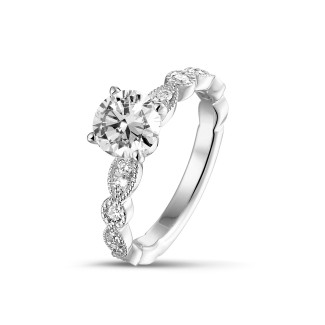
![1.00 carat solitaire stackable ring in platinum with a round diamond with marquise design]() 1.00 carat solitaire stackable ring in platinum with a round diamond with marquise designFrom € 4.622,20 (incl. 21% VAT)
1.00 carat solitaire stackable ring in platinum with a round diamond with marquise designFrom € 4.622,20 (incl. 21% VAT) -
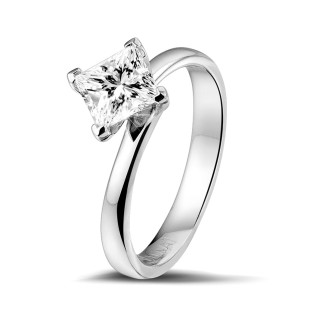
![1.00 carat solitaire ring in platinum with princess diamond]() Bestseller1.00 carat solitaire ring in platinum with princess diamondFrom € 3.484,80 (incl. 21% VAT)
Bestseller1.00 carat solitaire ring in platinum with princess diamondFrom € 3.484,80 (incl. 21% VAT) -
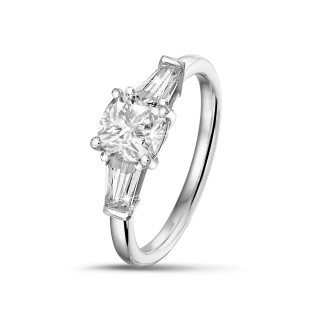
![1.00 carat trilogy ring in platinum with a cushion diamond and tapered baguettes]() Bestseller1.00 carat trilogy ring in platinum with a cushion diamond and tapered baguettesFrom € 6.376,70 (incl. 21% VAT)
Bestseller1.00 carat trilogy ring in platinum with a cushion diamond and tapered baguettesFrom € 6.376,70 (incl. 21% VAT) -
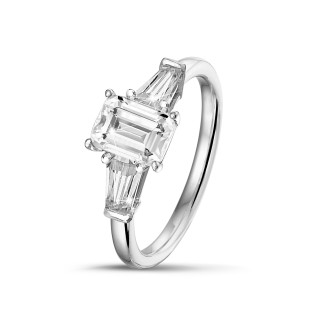
![1.00 carat trilogy ring in platinum with an emerald cut diamond and tapered baguettes]() Bestseller1.00 carat trilogy ring in platinum with an emerald cut diamond and tapered baguettesFrom € 7.804,50 (incl. 21% VAT)
Bestseller1.00 carat trilogy ring in platinum with an emerald cut diamond and tapered baguettesFrom € 7.804,50 (incl. 21% VAT) -
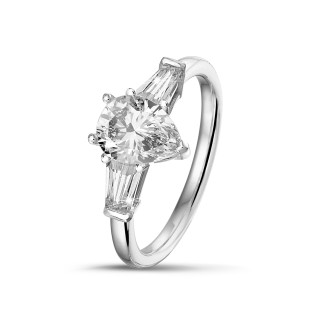
![1.00 carat trilogy ring in platinum with pear diamond and tapered baguettes]() Bestseller1.00 carat trilogy ring in platinum with pear diamond and tapered baguettesFrom € 7.247,90 (incl. 21% VAT)
Bestseller1.00 carat trilogy ring in platinum with pear diamond and tapered baguettesFrom € 7.247,90 (incl. 21% VAT)
Composition
Understanding alloys, karats and purity: what those numbers mean
Karat math for gold Karat numbers describe the share of pure gold in an alloy. Eighteen karat gold is 18 parts gold out of 24, equal to 75% pure gold; this is commonly called 18K. Fourteen karat gold is 14 parts gold out of 24, equal to 58.3% gold. Higher karat content gives a richer yellow tone in plain gold alloys and makes the metal softer and more malleable; lower karat alloys increase hardness through a larger share of alloying metals.Why karat matters for white gold
The gold percentage affects both colour and workability. An 18K white gold alloy starts from a higher gold content and is gentler to work, while lower-karat white gold alloys include more hardening metals that make the finished piece firmer and better at holding fine detail. At Baunat we focus on combinations that balance colour stability and long-term durability, noting that alloy choices influence plating behaviour and finish retention.Platinum fineness and hallmarks
Platinum jewellery is usually stamped to indicate its fineness. Common markings are .900 and .950, meaning 90% and 95% platinum respectively, the remainder being other metals added to improve casting and strength. A .950 platinum alloy contains a higher proportion of pure platinum and is the standard for many premium pieces because it combines purity with reliable structural properties.Hardness, alloys and practical durability
Alloying metals determine hardness. Typical white gold alloys contain hardening elements that can make the final alloy harder than pure platinum, which is why certain white gold rings resist surface deformation better initially. Platinum’s relative softness means it shows surface scratches as a subtle patina rather than sharp nicks; although it may scratch more visibly at first, these marks represent displaced metal, not material loss.Weight and density explained
Platinum is denser than gold, which creates a perceptible difference in heft. In practical terms, a platinum ring of the same external dimensions will feel heavier than a gold ring. This extra weight gives a distinct tactile impression and can influence how balanced a larger setting feels on the finger.Putting the numbers to use when choosing
When comparing metals, look at the karat and the platinum fineness stamp together with the intended design. If a ring requires extreme crispness in tiny settings, a harder white gold alloy may be preferable. For pieces where long-term volume, patina and hypoallergenic properties are priorities, a higher-fineness platinum alloy is often the better technical choice. These numeric cues set realistic expectations about finish, how the metal will wear, and what maintenance will be needed over the years 
White gold
BAUNAT for example alloys its white gold with palladium, a rare precious metal which ensures a long lasting colour of the white gold. At the end, white gold jewellery gets rhodium plated, which gives the jewel its bright white colour.
At BAUNAT, we go one step further. By composing all of our white gold jewellery with palladium instead of nickel, the jewellery retains its white colour longer and is an excellent choice for those with nickel allergies or sensitive skin.
Platinum
Colour
Which metal is best for different ring styles
Engraved patterns and mill-grain
Best choice: Platinum.Platinum is more malleable, which helps when creating continuous patterns and delicate mill-grain. The metal displaces rather than flakes, so fine engraving keeps its shape and resists edge loss over time. Practical example: an antique-style band with deep engraving and mill-grain edging will retain its sculpted look longer in platinum while developing an attractive patina.Pavé and small-stone settings
Best choice: White gold.White gold alloys can be harder than pure platinum, so they hold tiny prongs and bead settings securely and resist deformation during setting. Because the metal is firmer around each stone, very small pavé diamonds sit neatly and are less likely to loosen from slight knocks. Practical example: a delicate pavé halo engagement ring often performs better in white gold when stone security and crisp bead work are priorities.Fine claws and thin shanks
Best choice: White gold.Thin prongs and slender shanks need a metal that keeps crisp edges after finishing; harder white gold alloys retain fine claws and reduce the risk of bending with daily wear. This makes white gold a sensible choice for filigree-style rings or minimal solitaire settings with narrow profiles. Practical example: a solitaire with three ultra-fine claws and a narrow band is typically executed in white gold to preserve the delicate silhouette.Square or bevelled edges
Best choice: Platinum.Square shoulders and bevelled profiles benefit from a metal that can be worked without losing volume; platinum tends to displace metal rather than lose it, so edges remain substantial even as a soft patina forms. For designs that rely on bold geometry, platinum preserves mass and the intended visual weight. Practical example: a stepped, Art Deco ring with defined bevels will keep its architectural lines longer in platinum.Men’s classic bands
Best choice: Platinum (for weight) or white gold (for sharp finish), depending on preference.For traditional heavy wedding bands, platinum gives reassuring weight and a durable feel; for bands needing very crisp milled edges or a high-polish finish, white gold alloys provide a firmer surface. Consider whether perceived heft or edge retention is more important when choosing. Practical example: a broad comfort-fit platinum band feels substantial, while a milled, razor-edged white gold band keeps its crisp profile.Large, heavy rings and statement pieces
Best choice: Platinum.Heavier settings benefit from platinum’s greater density and structural integrity; larger rings show the advantage of a metal that displaces rather than loses material when scratched. The additional heft also balances large stones and elaborate mounts. Practical example: a multi-stone cocktail ring with a sizeable centre diamond will sit securely and feel well-balanced when cast in platinum.Highly detailed filigree or micro-etching
Best choice: White gold.Micro-detail work needs a finish that preserves tiny facets and sharp relief; white gold alloys harden to hold fine detail after finishing and are less prone to softening during polishing compared with pure platinum. Practical example: a filigree lace gallery with many tiny openwork elements is often crafted in white gold to retain intricate detail.Pairs and mixed-metal sets
Best choice: Match metals for rings worn together; choose metal by the piece's function.When engagement and wedding rings will be worn as a set, using the same metal minimises uneven wear and avoids differing maintenance cycles. If mixing is necessary for aesthetic reasons, place the ring that contacts the other least in the softer metal and plan for more frequent inspection. Practical example: pairing a platinum engagement ring with a white gold wedding band can cause uneven rubbing where metals meet, so couples often select the same metal for both rings for longevity.
White gold
Platinum
Due to the colour difference between platinum and white gold, experts don’t recommend a combination of these two precious metals. If your partner chooses a platinum engagement ring, then also go for a platinum wedding ring.
Pricing
Cost of platinum ring vs white gold
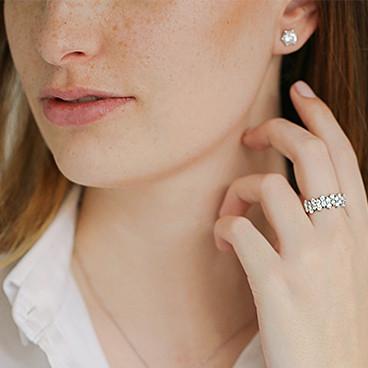
Admire this beautiful white gold ring from BAUNAT online
Another difference is that platinum is much rarer. Each year, fewer platinum ore is mined than gold ore. It concerns just under 200 tonnes compared to 1500 tonnes of gold ore respectively.
Maintenance
Resizing and maintenance: what to expect
Typical replating guidance
Advice on rhodium replating varies with wear patterns, lifestyle and initial finishing, but many wearers find replating becomes useful within a couple of years of regular use. Signs that replating is due include a subtle return of warmer tones at high-contact points and a loss of the original bright-white finish. Replating restores colour and surface uniformity, and should be considered a normal part of white gold ownership rather than a fault.What happens after resizing
White gold often needs re-rhodium after a resizing because the new soldered area will expose the underlying alloy. Platinum resizing is possible but usually requires specialist tools and techniques to preserve structure; the process differs from gold work because platinum is worked at different temperatures and reacts differently to soldering. Expect a careful jeweller to check settings and finishes after any resizing.Polishing versus replating
Polishing removes light surface marks and restores shine; replating renews the white protective layer. For white gold, polishing and replating go together: polishing prepares the surface and replating renews colour and uniformity. With platinum, polishing can brighten the finish but will not change the metal’s inherent white tone; many wearers appreciate the subtle patina that develops and choose gentle polishing only when necessary.Practical care and inspection
Regular visual checks are the simplest protection: look for loose stones, thinning prongs or colour changes where the metal contacts skin or other rings. If your ring is resized, request that settings and prongs are inspected and that any necessary reinforcement is carried out at the same time. Routine, professional inspections reduce the risk of surprise repairs and help preserve the ring’s long-term condition.White gold
Since 18 carat gold is harder than platinum, it is more likely to lose a little of its metal when scratched.
Last but not least, white gold jewellery can more easily be adjusted in size and the adaption is less visible.
Platinum
When it comes to adjusting your jewellery, platinum is harder. Due to the specific properties of platinum, you will most likely be able to see a line at the joint, even when the resizing was done properly because the soldering is of different alloy.
We do recommend that you clean platinum and gold jewellery yourself on a regular basis. You can easily do this by soaking the jewellery in a mixture of lukewarm water and soap. In time, it is recommended to have your platinum and white gold jewellery cleaned professionally by a jeweller.

Ready to choose your perfect engagement ring metal?
- White gold: Affordable, bright appearance, requires periodic maintenance.
- Platinum: Durable, naturally white, low maintenance, higher cost.
No matter your choice, both platinum and white gold create stunning engagement rings that beautifully symbolise your love and commitment.
If you're still uncertain, book a consultation with one of our expert jewellers at BAUNAT. We’re here to help you find the perfect ring that matches your style and budget. Experience the elegance and craftsmanship of our exquisite diamond jewellery today.
-
Stephanie Hesters
-
BAUNAT Antwerp
-
-
As the Head of Diamond Buying at BAUNAT, Stephanie has an extensive knowledge of the diamond and the evolution of diamond prices. Thanks to her broad product knowledge gained throughout her years at BAUNAT and the Diamond Foundation Course by De Beers, Stephanie advises our customers interested in the investment side of diamonds to optimize every investment. To support her skills she has a bachelor’s degree in Business Management together with her master’s in Communication.
About Stephanie Hesters (also known as Stephanie Lasters)
Stephanie Hesters, sometimes listed online as Stephanie Lasters, is Head of Diamond Buying at BAUNAT. She manages diamond sourcing and valuation, advises clients on market trends and pricing, and helps those looking for investment-grade stones. She completed the Diamond Foundation Course by De Beers and holds a bachelor’s degree in Business Management and a master’s in Communication.
Selected projects & collaborations
• Eternal Bloom Collection with Princess Delphine of Saxe-Coburg (2026), curator and project lead - guided creative direction and diamond selection for an exclusive collection that blends classical motifs with contemporary craftsmanship.
• Investment Diamonds Advisory Series (2024), author and presenter - developed client-facing guides and presentations on diamond valuation and market dynamics for private buyers and collectors.
• BAUNAT Editorial Features and Product Launches (2022–2025), contributor - worked with design and marketing teams to shape product narratives and ensure technical accuracy in launch materials and editorial content.
As the Head of Diamond Buying at BAUNAT, Stephanie has an extensive knowledge of the diamond and the evolution of diamond prices. Thanks to her broad product knowledge gained throughout her years at BAUNAT and the Diamond Foundation Course by De Beers, Stephanie advises our customers interested in the investment side of diamonds to optimize every investment. To support her skills she has a bachelor’s degree in Business Management together with her master’s in Communication.
About Stephanie Hesters (also known as Stephanie Lasters)
Stephanie Hesters, sometimes listed online as Stephanie Lasters, is Head of Diamond Buying at BAUNAT. She manages diamond sourcing and valuation, advises clients on market trends and pricing, and helps those looking for investment-grade stones. She completed the Diamond Foundation Course by De Beers and holds a bachelor’s degree in Business Management and a master’s in Communication.
Selected projects & collaborations
• Eternal Bloom Collection with Princess Delphine of Saxe-Coburg (2026), curator and project lead - guided creative direction and diamond selection for an exclusive collection that blends classical motifs with contemporary craftsmanship.
• Investment Diamonds Advisory Series (2024), author and presenter - developed client-facing guides and presentations on diamond valuation and market dynamics for private buyers and collectors.
• BAUNAT Editorial Features and Product Launches (2022–2025), contributor - worked with design and marketing teams to shape product narratives and ensure technical accuracy in launch materials and editorial content.