







Features:
-
Category:
-
Posted at:
-
Author:
- Fabienne Rauw
-
BAUNAT Antwerp
-


-
Reading time:9 minutes
In this article:
Buying diamonds: 5 things you did not know about diamonds
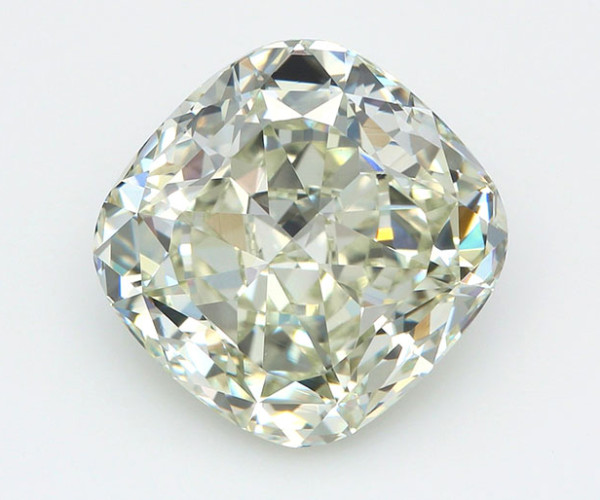
Diamond is one of the hardest materials in the world. It is a gemstone that traditionally captures the imagination the most. People buy diamond jewels to express their love to someone but also to show how powerful they are. It is a stone that inspires. A lot has been written about diamond(s), but there certainly are things you do not know:
Read summary
What fascinating secrets lie behind the world's most coveted gemstone?
Diamonds have captivated humanity for centuries, and there's more to these precious stones than meets the eye. While most know diamonds for their remarkable hardness and brilliance, their history holds surprising facts. The term "diamond" comes from the Greek "Adamas," meaning invincible, and these ancient gems are typically 1-3 billion years old - predating dinosaurs. The modern custom of diamond engagement rings began with Archduke Maximillian of Austria's proposal to Maria of Burgundy in 1477. Among colored diamonds, red is the rarest and most valuable, as evidenced by the Moussaieff red diamond's $8 million auction price. Even the familiar term "carat" has unique origins, derived from the remarkably consistent weight of Carob tree seeds, with one carat equaling 0.2 grams. These enduring stones continue to symbolize both love and power while carrying their ancient legacy into the present.
Most viewed diamond jewels
-
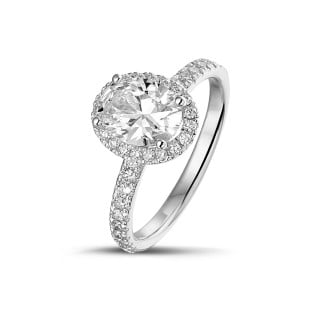
![1.00Ct halo ring in white gold with oval diamond]() Bestseller1.00Ct halo ring in white gold with oval diamondFrom € 5.578,10 (incl. 21% VAT)
Bestseller1.00Ct halo ring in white gold with oval diamondFrom € 5.578,10 (incl. 21% VAT) -
![1.00 carat solitaire cluster ring in white gold with marquise diamond]() BestsellerNew1.00 carat solitaire cluster ring in white gold with marquise diamondFrom € 4.622,20 (incl. 21% VAT)
BestsellerNew1.00 carat solitaire cluster ring in white gold with marquise diamondFrom € 4.622,20 (incl. 21% VAT) -
![0.95 carat diamond rose design ring in white gold]() NewPrincess Delphine0.95 carat diamond rose design ring in white goldFrom € 16.831,10 (incl. 21% VAT)
NewPrincess Delphine0.95 carat diamond rose design ring in white goldFrom € 16.831,10 (incl. 21% VAT) -
![1.00 carat solitaire ring with an asscher cut diamond in white gold]() Bestseller1.00 carat solitaire ring with an asscher cut diamond in white goldFrom € 4.936,80 (incl. 21% VAT)
Bestseller1.00 carat solitaire ring with an asscher cut diamond in white goldFrom € 4.936,80 (incl. 21% VAT) -
![1.00 carat solitaire ring with a cushion diamond and hidden halo in white gold]() BestsellerNew1.00 carat solitaire ring with a cushion diamond and hidden halo in white goldFrom € 4.210,80 (incl. 21% VAT)
BestsellerNew1.00 carat solitaire ring with a cushion diamond and hidden halo in white goldFrom € 4.210,80 (incl. 21% VAT)


Famous diamonds and their provenance
Hope Diamond - The Hope Diamond, now in the Smithsonian’s National Museum of Natural History, is a deep-blue stone of about 45.52 carats. Its documented history stretches to the 17th century and includes French royal ownership and later private collectors, which has helped shape its public fame.
Koh-i-Noor - The Koh-i-Noor originates in South Asia and passed through many hands over centuries, moving between regional dynasties and empires. Today a notable cut of the stone is part of the British crown jewels; its long, contested history continues to attract attention.
Dresden Green - The Dresden Green is a natural green diamond of roughly 41 carats that has been in European collections for centuries. Its unusual colour and long exhibition history made it a highlight of royal treasuries and museum displays.
Orlov Diamond - The Orlov, a large rose-cut stone, became famous as part of the Russian imperial sceptre. Its 18th-century provenance connects South Asian mining with later European collection history.
Provenance influences value because documented ownership and exhibition history confirm authenticity and create a narrative collectors and museums prize. Stones with well-established histories routinely attract higher bids and more scholarly and media attention.
Why coloured diamonds are rare - examples and records
Coloured diamonds get their hues from trace elements or from tiny distortions in the crystal lattice. Nitrogen, for example, can produce yellow tones; boron can produce blue; and intense pressure that deforms the lattice can yield pinks and reds. Those specific conditions occur only rarely during the slow, high-pressure processes that form gem-quality diamonds, which is why vivid natural colours are uncommon.
A few famous stones make the point. The Moussaieff Red, at 5.11 carats, is one of the very few natural red diamonds known and is prized for that extreme rarity. The Pink Star, a fancy vivid pink of 59.60 carats, proved exceptional because it combines large size with strong colour intensity - a rare pairing. There are likewise a handful of orange and orange-red stones that command attention precisely because pure orange and red tones are so scarce.
Auction houses such as Christie’s and Sotheby’s routinely show how intensity, size and a clear natural origin interact to set prices. Provenance - documented ownership or exhibition history - also matters: a well-documented past can increase collector interest and push a stone’s final bid higher. Collectors and museums value both the scientific rarity and the story each stone carries, which is why coloured diamonds often stand out in the market.
The English word “diamond” traces back to the Greek adamas, meaning invincible or untamed; this derivation appears in standard dictionaries and in early modern English usage, where authors linked the term to the mineral’s notable hardness and symbolic meanings. References in historical natural histories and lexicons record the word’s adoption across European languages from the late medieval period onward.
- Recently it has become very popular to buy jewels set with coloured diamonds. Did you know that red is by far the rarest colour for a diamond? And thereby the most expensive! A perfect example is the red Moussaieff diamond of 5.11 carat that was sold at an auction for 8 million American dollars.
- The average (mined) diamond is 1 to 3 billion years old. So, that means that the diamond processed in your favourite jewel is older that the oldest dinosaur.
The term carat comes from the carob seed, which merchants historically used as a convenient weight comparison because the seeds tended to have a consistent mass. As medieval and early modern trade networks expanded, jewellers and gem traders adopted the carob-based measure; over time that trader’s reference was standardized into the metric carat in use today. Etymological sources and metrology references document this shift from a seed-based trade convention to an internationally recognized weight standard.
- It used to be far from common to buy a diamond ring for your fiancée. The first diamond engagement ring ever given, was by archduke Maximillian of Austria to Maria of Burgundy in 1477.
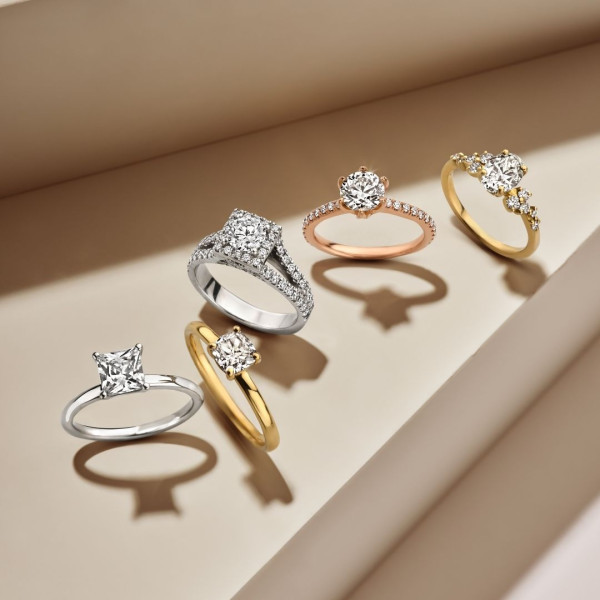
If you are considering to buy a diamond ring, then make sure to take a look at our broad collection. From diamond earrings to beautiful necklaces, we undeniably have a jewel that fits your style and taste. Do not hesitate to contact us.
-
Fabienne Rauw
-
BAUNAT Antwerp
-
-
Fabienne, manager of the German market is able to guide every client with finding the right jewel. She takes care of most of the German orders, but also takes other task on her plate. Thanks to her six years of experience at BAUNAT she acquainted well with the product and the marketing around it. Her degree in PR ensures that BAUNAT is well presented across all media channels. For anyone looking into a new investment opportunity, Fabienne is the perfect guide in this process. No question will be left unanswered, and she will help you every step of the way.
Selected Bespoke Projects
• Eternal Bloom bespoke engagement concept - Role: project lead for client briefing and prototype coordination. Fabienne translated personal design references into a 3D-printed prototype, supervised stone selection and ensured the finished piece matched the client’s vision and comfort preferences.
• Personalized anniversary necklace - Role: design coordinator and quality overseer. She managed the custom design process from the initial sketch to final polishing, liaising between client and workshop to preserve proportions and finish.
• Reimagined heirloom ring restoration and redesign - Role: client consultant and technical coordinator. Fabienne guided the client through options to modernize setting details while keeping sentimental elements, delivering a wearable result that respected the original piece.
Her hands-on involvement in bespoke commissions ensures each custom order has a clear brief, careful prototype review and close follow-up with the workshop, so clients receive a tailored jewel that meets both aesthetic and practical expectations.
Professional enquiries
For speaking engagements, press requests or research collaborations, please send your message to BAUNAT’s communications team with the subject line: "Fabienne Rauw - Professional Enquiry." Include a brief description of the request and any relevant dates or documents. The communications team will route enquiries to Fabienne and provide guidance on next steps.
Fabienne, manager of the German market is able to guide every client with finding the right jewel. She takes care of most of the German orders, but also takes other task on her plate. Thanks to her six years of experience at BAUNAT she acquainted well with the product and the marketing around it. Her degree in PR ensures that BAUNAT is well presented across all media channels. For anyone looking into a new investment opportunity, Fabienne is the perfect guide in this process. No question will be left unanswered, and she will help you every step of the way.
Selected Bespoke Projects
• Eternal Bloom bespoke engagement concept - Role: project lead for client briefing and prototype coordination. Fabienne translated personal design references into a 3D-printed prototype, supervised stone selection and ensured the finished piece matched the client’s vision and comfort preferences.
• Personalized anniversary necklace - Role: design coordinator and quality overseer. She managed the custom design process from the initial sketch to final polishing, liaising between client and workshop to preserve proportions and finish.
• Reimagined heirloom ring restoration and redesign - Role: client consultant and technical coordinator. Fabienne guided the client through options to modernize setting details while keeping sentimental elements, delivering a wearable result that respected the original piece.
Her hands-on involvement in bespoke commissions ensures each custom order has a clear brief, careful prototype review and close follow-up with the workshop, so clients receive a tailored jewel that meets both aesthetic and practical expectations.
Professional enquiries
For speaking engagements, press requests or research collaborations, please send your message to BAUNAT’s communications team with the subject line: "Fabienne Rauw - Professional Enquiry." Include a brief description of the request and any relevant dates or documents. The communications team will route enquiries to Fabienne and provide guidance on next steps.