








Features:
-
Category:
-
Posted at:
-
Author:
- Fabienne Rauw
-
BAUNAT Antwerp
-


-
Reading time:10 minutes
In this article:
- Anatomy of a Pear-Shaped Diamond and Why It Matters
- The Pear Cut Diamond: A Sparkling Pendeloque
- The Majestic Charm of Pear Cut Diamonds
- Determining the Ideal Proportions
- How to Evaluate Symmetry and the Bow-Tie in Pear Diamonds
- Exquisite Quality Diamonds For An Unforgettable Impression
- Color & Clarity: What to choose for a pear cut
- The Glamour of Pear Cut Diamonds: A Celeb Favorite
- Versatility of Pear Cut Diamonds In Jewellery
- Exploring Other Diamond Cuts
The Timeless Elegance of Pear Cut Diamonds
The allure of the diamond lies in its myriad forms, each exuding its unique charm and personality. Among the plethora of diamond cuts, the pear cut diamond stands in a class of its own. Be it in an engagement ring, necklace or earrings, the pear or teardrop-shaped diamond graces the wearer with an aura of sophisticated elegance.
Read summary
What makes pear cut diamonds so uniquely elegant?
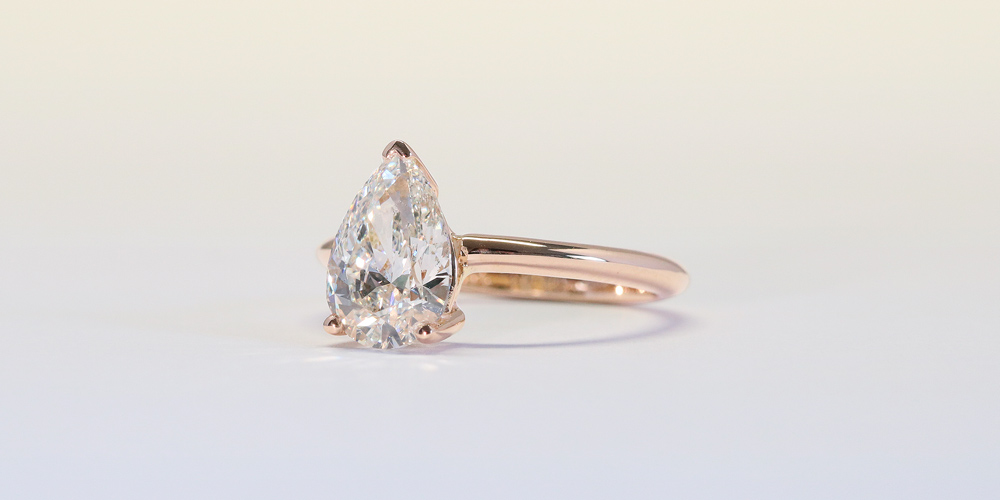
Pear cut diamonds blend the brilliance of round diamonds with the unique teardrop shape of a marquise cut, creating a sophisticated silhouette that stands out in any jewelry piece. Also known as pendeloques, these diamonds feature a round edge and a pointed tip that requires protective prong settings.
The ideal pear cut maintains a length-to-width ratio between 1.45 and 1.75, though personal preference may vary. Perfect symmetry between the two halves indicates superior quality.
These versatile gems enhance any jewelry type—elongating the neck as pendants, creating the illusion of slender fingers in rings, or adding royal elegance as earrings. Their rarity and uniqueness have made them favorites among celebrities like Victoria Beckham and Paris Hilton.
For those seeking exceptional pear cut diamond jewelry, BAUNAT offers certified pieces with outstanding cut quality, color, and clarity.
Most viewed diamond jewels
-
![1.00 carat solitaire cluster ring in white gold with a pear cut diamond]() BestsellerNew1.00 carat solitaire cluster ring in white gold with a pear cut diamondFrom € 4.791,60 (incl. 21% VAT)
BestsellerNew1.00 carat solitaire cluster ring in white gold with a pear cut diamondFrom € 4.791,60 (incl. 21% VAT) -
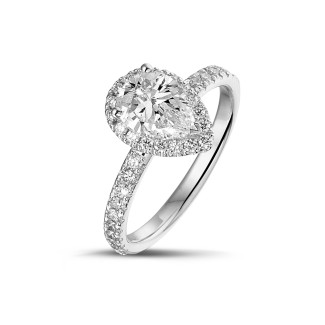
![1.00Ct halo ring in white gold with pear diamond]() Bestseller1.00Ct halo ring in white gold with pear diamondFrom € 5.541,80 (incl. 21% VAT)
Bestseller1.00Ct halo ring in white gold with pear diamondFrom € 5.541,80 (incl. 21% VAT) -
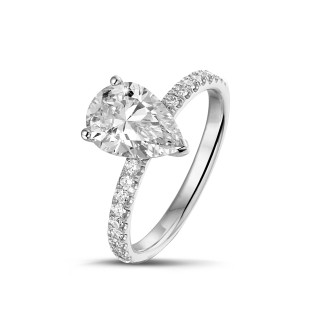
![1.00Ct solitaire ring in white gold with pear diamond]() Bestseller1.00Ct solitaire ring in white gold with pear diamondFrom € 4.948,90 (incl. 21% VAT)
Bestseller1.00Ct solitaire ring in white gold with pear diamondFrom € 4.948,90 (incl. 21% VAT) -
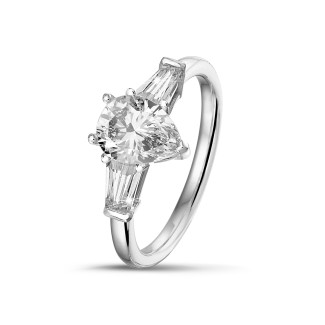
![1.00 carat trilogy ring in white gold with pear diamond and tapered baguettes]() Bestseller1.00 carat trilogy ring in white gold with pear diamond and tapered baguettesFrom € 6.824,40 (incl. 21% VAT)
Bestseller1.00 carat trilogy ring in white gold with pear diamond and tapered baguettesFrom € 6.824,40 (incl. 21% VAT) -
![1.00Ct halo ring in white gold with pear diamond]() Bestseller1.00Ct halo ring in white gold with pear diamondFrom € 4.985,20 (incl. 21% VAT)
Bestseller1.00Ct halo ring in white gold with pear diamondFrom € 4.985,20 (incl. 21% VAT)

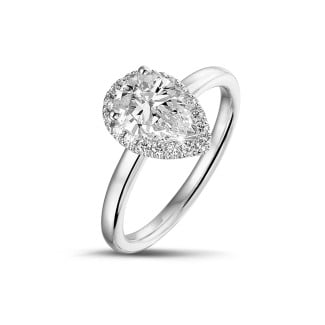
Anatomy of a Pear-Shaped Diamond and Why It Matters
Anatomy of a pear-shaped diamond affects how it looks and wears. Knowing the main parts - table, crown, girdle, pavilion, culet, shoulders (wings) and the pointed tip - helps you judge brightness, spread and durability.
The table is the large, flat facet on top; it strongly influences face-up brightness and how much light returns to the eye. The crown slopes down from the table and, together with the table, produces fire and sparkle. The pavilion is the lower section; its depth determines whether light is returned or lost. A pavilion that’s too deep or too shallow will leak light and reduce brilliance. The girdle defines the stone’s edge and affects how the setting holds the diamond. The culet is a tiny facet at the very bottom; when centred and proportioned correctly it prevents a dark spot in the face-up view. If the culet or table is off centre, symmetry and even brightness suffer.
The pointed tip gives the pear its distinctive outline but is also a vulnerable spot: inclusions or weak facet junctions near the point raise the risk of chipping. Avoid stones with clarity issues concentrated at the tip.
Practical checks to ask for when buying: confirm that the table and culet are centred along the lengthwise axis; request clear, magnified photos of the tip area and a profile image showing crown and pavilion proportions. These checks reveal potential asymmetry, light leakage or thin girdle sections that could affect setting security and wear over time. They help ensure the pear you choose has even brilliance and a durable mounting.
The Pear Cut Diamond: A Sparkling Pendeloque

The Majestic Charm of Pear Cut Diamonds
Determining the Ideal Proportions
How to Evaluate Symmetry and the Bow-Tie in Pear Diamonds
Inspection checklist
- Centreline alignment: view the diamond with its length axis vertical. The widest point should sit evenly left to right; the two halves should mirror each other. Any lean suggests asymmetry.
- Table and culet centring: check that the table aligns with the centreline and that any culet lies on that same axis. Off‑centre placement shifts brightness to one side.
- Mirror halves: confirm equal facet patterns on both wings and near the tip; mismatched shoulders or facet sizes reduce perceived quality.
- Profile and girdle: look at the girdle profile for even thickness and a straight outline; large variations can complicate fitting the setting.
Assessing the bow-tie
- The bow-tie is a darker, bow-shaped shadow across the centre caused by facet angles and pavilion alignment that block returning light. Examine the stone in direct spotlights, under diffused light and in daylight. A faint, narrow bow-tie can be acceptable if it does not dominate the table and overall sparkle stays strong. A wide, dark bow-tie that remains visible from many angles reduces face-up performance.
When a bow-tie is acceptable vs problematic
- Acceptable: narrow or soft, only visible from some angles; brilliance remains good. - Problematic: large and dark, noticeable from most views and reducing perceived sparkle.
Common asymmetry issues and effects
- Off-centre tip or table: creates uneven brightness and a lopsided look. - Unequal shape: one side appears heavier, harming elegance. - Misaligned culet: causes uneven light return and an unbalanced face-up.
Actionable buying steps
- Request multiple-angle photos and short videos of the diamond on a neutral background under both diffused and directional light. Ask for face-up and profile views, and for diagrams that indicate the centreline when available. These images let you judge whether symmetry and the bow-tie will enhance or detract from the pear’s appearance.

Exquisite Quality Diamonds For An Unforgettable Impression
Color & Clarity: What to choose for a pear cut
Clarity decisions should consider where inclusions sit as much as their grade. Avoid stones with significant inclusions near the point or on the crown; those are visible face-up and the tip area is more prone to damage. Inclusions located near the girdle or deep in the pavilion are usually less obvious from the face-up view, but always request magnified photos centred on the point and crown.
Why this matters: the pear’s facet layout channels light along the length toward the tip, so any color or inclusion there draws attention. Practical steps include asking to see the stone mounted in the intended metal or, if that is not available, comparison photos on white and yellow backgrounds to judge color appearance. These checks help ensure the pear chosen looks bright and clean in its final setting.
The Glamour of Pear Cut Diamonds: A Celeb Favorite

Versatility of Pear Cut Diamonds In Jewellery


Exploring Other Diamond Cuts
-
Fabienne Rauw
-
BAUNAT Antwerp
-
-
Fabienne, manager of the German market is able to guide every client with finding the right jewel. She takes care of most of the German orders, but also takes other task on her plate. Thanks to her six years of experience at BAUNAT she acquainted well with the product and the marketing around it. Her degree in PR ensures that BAUNAT is well presented across all media channels. For anyone looking into a new investment opportunity, Fabienne is the perfect guide in this process. No question will be left unanswered, and she will help you every step of the way.
Fabienne, manager of the German market is able to guide every client with finding the right jewel. She takes care of most of the German orders, but also takes other task on her plate. Thanks to her six years of experience at BAUNAT she acquainted well with the product and the marketing around it. Her degree in PR ensures that BAUNAT is well presented across all media channels. For anyone looking into a new investment opportunity, Fabienne is the perfect guide in this process. No question will be left unanswered, and she will help you every step of the way.