







Features:
-
Category:
-
Posted at:
-
Author:
- Stephanie Hesters
-
BAUNAT Antwerp
-


-
Reading time:13 minutes
In this article:
- Weddings in Botswana: exploring rich traditions and diamond heritage
- Guinean wedding traditions: how do people get married in oil-rich Equatorial Guinea?
- Weddings in Congo: dowry negotiations and post-wedding rituals
- What are the most special African marriage traditions?
- More a fan of classic wedding traditions with rings?
- Frequently asked Questions
African wedding traditions: unique rituals revealed
Aren’t traditions the cornerstone of every society? Rituals and ceremonies, passed on from generation to generation. As far as engagement and marriage is concerned, it is no different. Everywhere in the world people interpret this unique event in their own way. Sometimes even on a local or family level.
Similarly in Africa, where different traditions exist between different tribes in the same country or region. But one thing stands out: buying a ring for the marriage proposal or the marriage ceremony is not common. How do people propose in Africa? And what are the most typical African wedding traditions?
Read summary
How Do African Wedding Traditions Differ From Western Customs?
While Western weddings often center around the exchange of rings, traditional African marriages feature distinctive customs that vary across regions and tribes. In Botswana, a prospective groom typically offers eight cows as bogadi (dowry) to the bride's family, and couples must receive permission from the local chief. In Equatorial Guinea, particularly among the Fang tribe, polygamy is accepted, and newly married couples join the man's family until financially independent.
Congolese weddings involve elaborate dowry negotiations where the groom cannot speak, only his male relatives. A unique post-wedding tradition involves female relatives checking the marriage bed to confirm the bride's virginity. Other fascinating customs include the Shona tribe's surprise nighttime visits, the Sudanese Lakuta tribe's symbolic kidnapping ritual, and the widely practiced "jumping the broom" ceremony—a tradition born during slavery when formal marriages were forbidden.
Most viewed diamond jewels
-
![1.75 carat full-set eternity ring with marquise cut diamonds in white gold]() Bestseller1.75 carat full-set eternity ring with marquise cut diamonds in white goldFrom € 7.586,70 (incl. 21% VAT)
Bestseller1.75 carat full-set eternity ring with marquise cut diamonds in white goldFrom € 7.586,70 (incl. 21% VAT) -
![0.26 carat half-set eternity ring in white gold - matches with all rings from the Fancy Shapes collection]() Bestseller0.26 carat half-set eternity ring in white gold - matches with all rings from the Fancy Shapes collectionFrom € 2.904,00 (incl. 21% VAT)
Bestseller0.26 carat half-set eternity ring in white gold - matches with all rings from the Fancy Shapes collectionFrom € 2.904,00 (incl. 21% VAT) -
![0.90 carat eternity ring (full set) in white gold with princess diamonds]() Bestseller0.90 carat eternity ring (full set) in white gold with princess diamondsFrom € 3.956,70 (incl. 21% VAT)
Bestseller0.90 carat eternity ring (full set) in white gold with princess diamondsFrom € 3.956,70 (incl. 21% VAT) -
![Stackable beaded ring in white gold]() Stackable beaded ring in white goldFrom € 1.742,40 (incl. 21% VAT)
Stackable beaded ring in white goldFrom € 1.742,40 (incl. 21% VAT) -
![0.22 carat half-set eternity ring in white gold - matches with specific rings from the BAUNAT Iconic collection]() Bestseller0.22 carat half-set eternity ring in white gold - matches with specific rings from the BAUNAT Iconic collectionFrom € 3.206,50 (incl. 21% VAT)
Bestseller0.22 carat half-set eternity ring in white gold - matches with specific rings from the BAUNAT Iconic collectionFrom € 3.206,50 (incl. 21% VAT)


Weddings in Botswana: exploring rich traditions and diamond heritage
We start our search for typical African wedding traditions in Botswana. After discovering diamonds in 1967, a year after their independence, this country experienced rapid economic growth. Although Botswana is no longer the largest diamond producer in the world, it remains an important source of income.
If you want to buy a diamond ring to propose with, there is a big chance that the diamond was mined from the soil of this African country. Prince Harry also had a diamond from Botswana set into his engagement ring for Meghan Markle.
To ask his intended bride’s hand in marriage, it is customary for the husband to donate 8 cows to the bride's family. Although the family of the bride sometimes asks for cloth, clothing or money instead of cattle. It may take several years before this dowry or 'bogadi' is fully paid off. It has even occurred that the woman has died before the man has fully paid it off through his so-called repayment plan.
In order to be able to get married, the couple must also receive permission from the 'kgosi', the local chief. Those who object to the marriage can take this up with the kgosi. If everyone agrees, especially the two families of the couple, the marriage can go ahead.
An important part of the marriage process is 'go laya'. The older women take the young bride under their wings to teach her everything about marriage and motherhood. The most important lesson: never doubt the words and actions of your husband because he is the head of the family!
Guinean wedding traditions: how do people get married in oil-rich Equatorial Guinea?
In Equatorial Guinea, Guinean wedding traditions offer a fascinating glimpse into the country's rich cultural tapestry. Equatorial Guinea is located in the west of Africa and consists of both the continental part of Mbini and the island of Bioko, where the capital Malabo is located. Thanks to oil extraction, it is one of the richest African countries. Unfortunately also one of the most corrupt, which is why a large part of the population still lives below the poverty line.
Although the country was a Spanish colony for 190 years and the Spanish culture as well as the Christian faith are certainly noticeable, a large part of the population lives according to the old customs and traditions. This also applies to the Fang, one of the largest tribes in the country. Polygamy is accepted, and it is very common for wives to live in a separate hut together with their own sons, albeit under strict rules of the father.
In Equatorial Guinea, also, buying a ring, making a ring or giving a ring is not part of the marriage proposal. Giving a dowry is still customary. When a couple marries, they usually join the man's family until they are financially independent. Separations hardly occur, but if this happens, the dowry must be repaid to the groom.
Strong family ties are the cornerstone of their society. It is a strong social safety net for the locals. To include the bride in the bridegroom's family, people celebrate and dance exuberantly during the three-day wedding party.
Weddings in Congo: dowry negotiations and post-wedding rituals
The former Belgian colony of Congo in central Africa is rich in minerals and ores, yet 80% of the population lives below the poverty line. Corruption, inefficiency and civil wars lie at the basis of their weak economy.
In Congo too, it is more common to buy a goat, chickens, clothing or other gifts for the bride's family than an engagement ring. When a man expresses his intention to marry, both families come together to negotiate the dowry. It is forbidden for the future groom to talk. His father or uncle speaks.
Weddings in Congo are warm and personal with dancing, singing, prayers and humour. However, there is no laughter until after the ceremony. Otherwise, it would mean that the bride and groom are not taking their vows seriously. There is still plenty of room for laughter and fun afterwards.
The most unusual Congolese marriage tradition takes place after the wedding night. Women from both sides of the family check the bed of the new couple. If no blood is found, the virginity cannot be confirmed and the groom can still cancel the marriage and demand his dowry back.
What are the most special African marriage traditions?
Traditional African marriages are a vibrant tapestry of customs and rituals that vary widely across the continent, each reflecting unique cultural values and historical contexts.
In Swahili culture also, it is customary to prove the virginity of the bride. But they take it one step further. For example, it is not uncommon for a female family member to lie under the bed to prevent the couple not consummating the marriage.
For the Shona tribe in Zimbabwe, the marriage starts with the wedding night. When the bride-to-be decides that she is ready to marry, she goes to the home of her future husband, under the cloak of darkness and accompanied by female family members. They do this to test how the family deals with 'emergency situations'. This unannounced visit ends with a real party.
And talking about emergency situations: with the Sudanese Lakuta tribe there is a kidnapping and a fighting involved. When a man has chosen his bride, he kidnaps her to show his interest. Then he goes with elderly family members to the father of the bride to get permission for the marriage. If the father agrees, he fights with his future son-in-law.
The most popular, yet unique and typically African marriage tradition is undoubtedly the jumping over the broom. This broom ceremony reflects the coming together of the two families and also pays tribute to previous generations. This ritual was created during the time of slavery, when often marriages were not allowed. It was for them a public confirmation of their marriage. Sometimes the brooms were also waved about during the wedding ceremony. This way, evil spirits would be expelled and any mistakes from the past would be erased.
More a fan of classic wedding traditions with rings?
Buying a ring, whether it is an engagement ring or a wedding ring, it is clearly not customary in traditional African culture. Do you want to buy a ring to get engaged, however? Discover BAUNAT’s extensive collection of engagement rings. Are you already engaged? Then be sure to check out our stylish wedding rings for him and her.
For additional advice and guidance you can always contact the BAUNAT experts via telephone, mail or chat.
Frequently asked Questions
Can you buy an engagement ring without knowing the size? Tips on measuring for an engagement ring.
- How can I secretly measure their ring size?
- How do I go about measuring my loved one’s finger?
- When is the best time to take their measurements?
Buying a diamond or gold engagement ring is a beautiful way of showing your love, but it is no mean feat. Even if you know which rings they love and have decided on a detailed design, you still need to figure out your loved one’s ring size. Can you buy an engagement ring without knowing the size? Unfortunately not, but there are ways you can measure their ring size without them noticing!
What different styles of diamond engagement ring settings does BAUNAT offer?
- The solitaire prong setting has one single diamond held in place by prongs, so it catches the most light.
- The pavé setting positions many diamonds in a row so closely that hardly any metal is visible, resulting in a brilliant shine.
- Channel setting is a method where diamonds are suspended between two rails of metal, called channels.
- The bezel setting is a traditional, labour-intensive technique where the metal surrounds the diamond and forms a frame around the stone.
1. The Prong setting
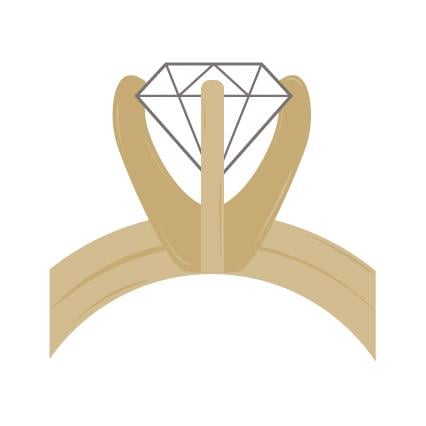
The solitaire prong setting has one single diamond that acts as the centrepiece of the ring. Claws position the centre diamond so it catches the most light. BAUNAT diamond engagement rings either have four or six claws. A setting with four claws makes the diamond appear more square-like while one with six claws makes it appear more round.
The name ‘prong setting’ refers to the so-called ‘claws’. The prong setting is most commonly used for engagement rings worldwide. This setting is also suitable for almost all shapes of diamonds.
The claws can be very thin or wider and can be finished in a round, square, or pointed shape. This depends on the design of the jewel and the style of each goldsmith.
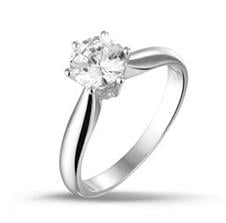
Order this white gold prong setting engagement ring today.
The advantages of the prong setting:
- The diamond catches the most light
- The prongs are small, therefore a larger part of the diamond is visible
- The diamond in the ring is easy to clean
- Claws in white gold or platinum are barely visible on the white diamond
2. The pavé setting
.jpg)
The term 'pavé setting' comes from the French language and translates as ‘paved’. The individual small diamonds in a pavé diamond ring resemble tiny paving stones, hence the name. In an engagement ring with a pavé setting, small diamonds are placed next to each other and fixed with small prongs that look like beads. These claws are worked out directly from the gathering point of the metal. This way, hardly any metal is visible.
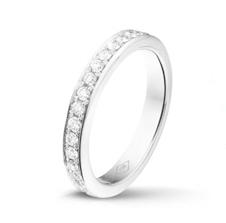
The advantages of pavé setting:
- The many small prongs make the diamonds sparkle, although only small diamonds are used
- The price of a ring with many smaller stones is considerably lower than a ring set with one big diamond
3. The Channel setting

Channel setting is a method where diamonds are suspended between two rails of metal, called channels. The diamond is put in place, and the metal on top is pushed down, tightening the diamond.
This way, we create a continuous line of diamonds.
Channel settings, together with pave settings, are commonly used for diamond alliance rings and wedding bands. At BAUNAT, most of our designs with channel settings have princess-cut diamonds, but we can also use round or baguette diamonds (tailor-made).
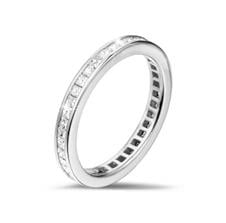
Discover this channel set round diamond engagement ring.
The advantages of the channel setting
- Because the diamonds are placed next to each other, it gives the impression of continuous brilliance
- The surface is very smooth
- These rings can be combined with other ring designs easily
4. The Bezel setting
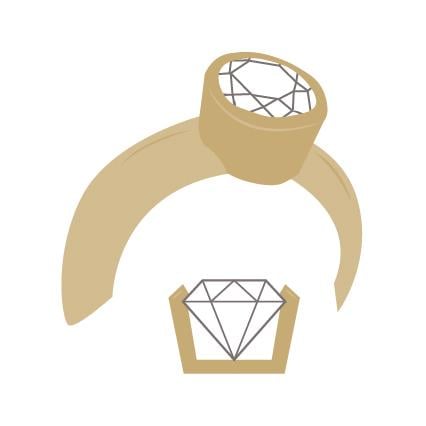
The bezel setting is a traditional, very labour-intensive goldsmith technique. The metal surrounds the diamond and forms a frame around the stone. There is another precious metal strip (frame), which supports the diamond in the socket. The bezel engagement ring setting is particularly well suited for round cut (brilliant) or oval diamonds.
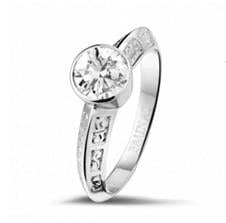
The advantages of the bezel setting
- Because of the border of the precious metal, the diamond is protected against damage
- The bezel is open at the bottom, creating a higher radiance and more fire
- Because of the metal surrounding the diamond, it will appear larger than it actually is
- Because of the fact that there are no prongs, this setting will not get stuck behind any clothing
Choose your favorite setting with your BAUNAT ring.
These are the most common setting methods. Of course, BAUNAT can also offer other types of settings in her tailor-made jewellery. Please contact info@baunat.com in case you are interested in a tailor-made jewel with a different diamond setting.
Related information:
1. What collections are available?
2. What to consider when choosing the perfect engagement ring?
How to wear your engagement ring and wedding ring?
In most Western cultures, the engagement ring is worn on the ring finger of the left hand. In the past, people believed that this finger was the 'artery of love' that was connected directly to the heart. After marriage in some countries, the engagement ring is moved to the middle finger of the left hand to make room for the wedding ring on the ring finger. Here, most people wear both rings on the left hand, although some prefer to wear the wedding ring on the right-hand ring finger.
-
Stephanie Hesters
-
BAUNAT Antwerp
-
-
As the Head of Diamond Buying at BAUNAT, Stephanie has an extensive knowledge of the diamond and the evolution of diamond prices. Thanks to her broad product knowledge gained throughout her years at BAUNAT and the Diamond Foundation Course by De Beers, Stephanie advises our customers interested in the investment side of diamonds to optimize every investment. To support her skills she has a bachelor’s degree in Business Management together with her master’s in Communication.
As the Head of Diamond Buying at BAUNAT, Stephanie has an extensive knowledge of the diamond and the evolution of diamond prices. Thanks to her broad product knowledge gained throughout her years at BAUNAT and the Diamond Foundation Course by De Beers, Stephanie advises our customers interested in the investment side of diamonds to optimize every investment. To support her skills she has a bachelor’s degree in Business Management together with her master’s in Communication.