







Features:
-
Category:
-
Posted at:
-
Author:
- Fabienne Rauw
-
BAUNAT Antwerp
-


-
Reading time:11 minutes
In this article:
The history of oval diamonds
Today, most diamonds are by far prepared in the classic circular cut, for example, for setting in a diamond ring. The high demand is mainly due to the fact that a round, brilliant-cut diamond is considered to be the most brilliant in the truest sense of the word. Do you want to stand out from the crowd and are looking for a special cut that not everyone wears? Then you should take a closer look at oval diamonds!
The benefits of an oval cut: the elongated shape conveys additional elegance and on top of that, an oval stone with the same carat weight looks slightly larger than a round one.
Read summary
What makes oval-cut diamonds a unique choice for jewelry, and how did they evolve into their modern form?
Oval-cut diamonds offer a distinctive alternative to traditional round brilliant cuts, combining elegance with individuality. While oval diamonds have existed for centuries, their modern brilliant cut was pioneered in 1957 by Russian diamond cutter Lazare Kaplan, who learned from his uncle Abraham Tolkowsky. Kaplan's innovative technique transformed previously unwearable damaged stones into smaller, flawless diamonds.
Oval diamonds possess several appealing characteristics. Their elongated shape creates an illusion of larger size compared to round diamonds of equal carat weight. While they may display a "bow tie" effect - a shadow through the center visible from certain angles - this isn't considered a flaw. The ideal length-to-width ratio is typically 1:4, though this can vary based on the ring design.
These unique stones are particularly popular for second engagements or among those seeking to express their individuality through distinctive jewelry pieces.
Most viewed diamond jewels
-
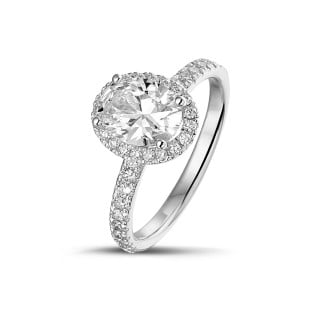
![1.00Ct halo ring in white gold with oval diamond]() Bestseller1.00Ct halo ring in white gold with oval diamondFrom € 5.578,10 (incl. 21% VAT)
Bestseller1.00Ct halo ring in white gold with oval diamondFrom € 5.578,10 (incl. 21% VAT) -
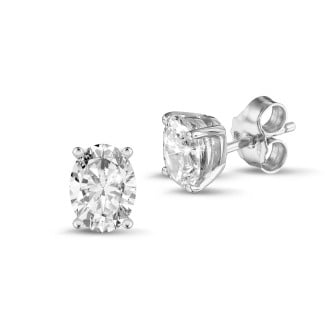
![2.00 carat solitaire oval cut diamond earrings in white gold]() Bestseller2.00 carat solitaire oval cut diamond earrings in white goldFrom € 8.119,10 (incl. 21% VAT)
Bestseller2.00 carat solitaire oval cut diamond earrings in white goldFrom € 8.119,10 (incl. 21% VAT) -
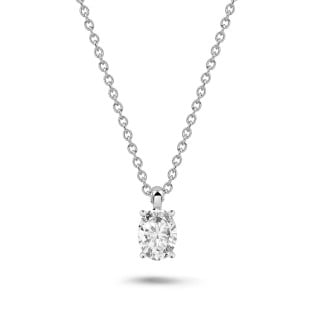
![1.00 carat solitaire oval cut diamond pendant in white gold]() Bestseller1.00 carat solitaire oval cut diamond pendant in white goldFrom € 4.755,30 (incl. 21% VAT)
Bestseller1.00 carat solitaire oval cut diamond pendant in white goldFrom € 4.755,30 (incl. 21% VAT) -
![0.15 carat solitaire ring with a oval cut diamond in white gold]() New0.15 carat solitaire ring with a oval cut diamond in white goldFrom € 2.323,20 (incl. 21% VAT)
New0.15 carat solitaire ring with a oval cut diamond in white goldFrom € 2.323,20 (incl. 21% VAT) -
![1.00Ct solitaire ring in white gold with oval diamond and hidden halo]() BestsellerNew1.00Ct solitaire ring in white gold with oval diamond and hidden haloFrom € 5.251,40 (incl. 21% VAT)
BestsellerNew1.00Ct solitaire ring in white gold with oval diamond and hidden haloFrom € 5.251,40 (incl. 21% VAT)


The modern oval cut
Even though oval-cut diamonds have existed in rings for hundreds of years, they only appeared in the modern brilliant cut in 1957, first accomplished by the Russian diamond cutter Lazare Kaplan, who learned his craft from his famous uncle Abraham Tolkowsky. Kaplan became known for his sophisticated technique of splitting damaged stones or diamonds with pronounced inclusions, previously largely considered to be worthless, and splitting them up into smaller diamonds so that the smaller stones were flawless at the end. However, his great breakthrough came with the oval cut, which still secures him a place among the greats of diamond cutters today.
Famous oval diamonds and milestones
Koh-i-Noor (pre‑1852, recut 1852) - Once fashioned as a large Mughal‑era stone, the Koh-i-Noor was reshaped several times before its notable reduction in the mid‑19th century. That recut reflects an important historic shift from older, deep cuts toward faceting approaches that prioritised light return and wearable proportions, trends that ultimately fed interest in elongated and brilliant cuts, including the oval.
Noor‑ul‑Ain (c. late 18th–19th century) - Originally part of Mughal and later Persian and Indian treasuries, this prominent oval or slightly elongated stone illustrates how Eastern cutting traditions and royal patronage kept elongated shapes in the public eye long before modern European brilliant cutting popularised them.
Pigot Diamond (early 19th century) - Recut and reset multiple times across auctions and collections, the Pigot story shows how cutters and owners have historically adjusted a stone’s shape and proportions to suit contemporary tastes, a dynamic that parallels the later refinement of the modern oval brilliant.
Pink Star (modern auction star) - Although not an historic oval, recent high‑profile auction diamonds such as the Pink Star demonstrate how large, eye‑catching stones drive market attention and collector demand for distinctive cuts. Such headline sales indirectly boosted interest in fancy and elongated shapes, including bespoke oval commissions.
Beluga and notable auction stones (20th–21st century) - Several auction houses have sold large, elongated and modified brilliant diamonds under prestigious sale rooms, creating public moments that familiarised collectors and the wider public with non‑round shapes. Those sales helped normalise wearing elongated brilliants in high jewellery and engagement rings.
Each of these milestones ties back to how cutters and markets shaped public taste. From royal ornaments and adaptive recuts to modern auction highlights, named stones and headline sales helped shift preference away from older forms toward faceted, elongated brilliants. That cultural and commercial exposure set the stage for the modern oval cut to become both a fashionable and technically refined choice.
What do you have to look out for when it comes to oval diamonds?
The ratio of length to width varies with oval-cut diamonds; a good guide value is an aspect ratio of 1:4, also depending on the type of ring. For a ring with smaller diamonds surrounding a central oval stone, for example, we recommend a slightly greater length in relation to the width in contrast to a solitaire ring.
As with all asymmetrical cuts, oval diamond rings can have the so-called “bow tie” effect, which gets its name from the shadow cast through the centre of the diamond in the shape of a bow tie. It is not an indication of a flaw or a bad cut; however, there are also completely different opinions among experts as to whether or not this effect, which can only be perceived from close up and from a very specific angle, is desirable. For most oval-cut diamonds this effect is not very pronounced; for some stones it is stronger and it is hard to avoid completely without affecting the quality of the diamond. This is decided by personal taste alone.
An extraordinary diamond in an individually designed ring, which also emphasises the uniqueness of its wearer, is particularly beautiful. They are also ideal for those are getting married for a second time because the ring for the second engagement should differ as much as possible from the first engagement ring, should there be one.
Are you looking for a fast and efficient way to design a highly individual, perfect piece of jewellery? The BAUNAT experts will be happy to advise you and help you from the design right through to implementation. Get in touch!
Modern oval proportions and minimizing the bow‑tie
Ovals are most commonly cut with a brilliant facet arrangement totalling 58 facets, the same basic faceting count as a round brilliant but adapted to an elongated outline. Modern proportions that consistently deliver pleasing light return while keeping the bow‑tie effect under control fall into relatively narrow numeric ranges. A practical guideline is a length:width ratio between about 1.35 and 1.50, with many buyers preferring the 1.40–1.45 band for a balance of elegance and face‑up size.
Table and depth percentages also matter. Aim roughly for a table percentage in the neighborhood of 53–63 percent and a total depth of about 57.5–62 percent. When table or depth stray far outside these ranges, light performance and the apparent size of the stone can be compromised, or the bow‑tie can become more prominent.
How proportions influence the bow‑tie
- Longer ratios tend to spread the star and kite facets more, which can disperse the dark bow‑tie area and make it less obtrusive. If you dislike the bow‑tie, prefer ratios at the longer end of the recommended range.
- Shallower or very deep profiles alter pavilion angles and can intensify the bow‑tie or reduce scintillation. Small adjustments to crown and pavilion angles are what cutters use to balance brilliance and bow‑tie visibility.
Extra facets and what they mean for oval diamonds
An "extra facet" is an additional, usually small, planar surface a cutter adds beyond the standard facet scheme. Cutters introduce these facets to remove surface blemishes, repair a nick, or preserve carat weight when an otherwise valuable stone would be significantly reduced by a traditional polish. In ovals the extra facets are commonly placed on the pavilion or near the girdle and are often not visible from the top.
Why it matters for oval buyers
Added facets can be entirely unobtrusive or, if large or poorly positioned, they can affect symmetry and light return. Because ovals rely on balanced facet patterns to manage contrast and the bow‑tie, an oversized extra facet can create an unexpected dark area or
-
Fabienne Rauw
-
BAUNAT Antwerp
-
-
Fabienne, manager of the German market is able to guide every client with finding the right jewel. She takes care of most of the German orders, but also takes other task on her plate. Thanks to her six years of experience at BAUNAT she acquainted well with the product and the marketing around it. Her degree in PR ensures that BAUNAT is well presented across all media channels. For anyone looking into a new investment opportunity, Fabienne is the perfect guide in this process. No question will be left unanswered, and she will help you every step of the way.
Selected Bespoke Projects
• Eternal Bloom bespoke engagement concept - Role: project lead for client briefing and prototype coordination. Fabienne translated personal design references into a 3D-printed prototype, supervised stone selection and ensured the finished piece matched the client’s vision and comfort preferences.
• Personalized anniversary necklace - Role: design coordinator and quality overseer. She managed the custom design process from the initial sketch to final polishing, liaising between client and workshop to preserve proportions and finish.
• Reimagined heirloom ring restoration and redesign - Role: client consultant and technical coordinator. Fabienne guided the client through options to modernize setting details while keeping sentimental elements, delivering a wearable result that respected the original piece.
Her hands-on involvement in bespoke commissions ensures each custom order has a clear brief, careful prototype review and close follow-up with the workshop, so clients receive a tailored jewel that meets both aesthetic and practical expectations.
Professional enquiries
For speaking engagements, press requests or research collaborations, please send your message to BAUNAT’s communications team with the subject line: "Fabienne Rauw - Professional Enquiry." Include a brief description of the request and any relevant dates or documents. The communications team will route enquiries to Fabienne and provide guidance on next steps.
Fabienne, manager of the German market is able to guide every client with finding the right jewel. She takes care of most of the German orders, but also takes other task on her plate. Thanks to her six years of experience at BAUNAT she acquainted well with the product and the marketing around it. Her degree in PR ensures that BAUNAT is well presented across all media channels. For anyone looking into a new investment opportunity, Fabienne is the perfect guide in this process. No question will be left unanswered, and she will help you every step of the way.
Selected Bespoke Projects
• Eternal Bloom bespoke engagement concept - Role: project lead for client briefing and prototype coordination. Fabienne translated personal design references into a 3D-printed prototype, supervised stone selection and ensured the finished piece matched the client’s vision and comfort preferences.
• Personalized anniversary necklace - Role: design coordinator and quality overseer. She managed the custom design process from the initial sketch to final polishing, liaising between client and workshop to preserve proportions and finish.
• Reimagined heirloom ring restoration and redesign - Role: client consultant and technical coordinator. Fabienne guided the client through options to modernize setting details while keeping sentimental elements, delivering a wearable result that respected the original piece.
Her hands-on involvement in bespoke commissions ensures each custom order has a clear brief, careful prototype review and close follow-up with the workshop, so clients receive a tailored jewel that meets both aesthetic and practical expectations.
Professional enquiries
For speaking engagements, press requests or research collaborations, please send your message to BAUNAT’s communications team with the subject line: "Fabienne Rauw - Professional Enquiry." Include a brief description of the request and any relevant dates or documents. The communications team will route enquiries to Fabienne and provide guidance on next steps.