


Features:

Share on:

Rules for engagement rings you should consider

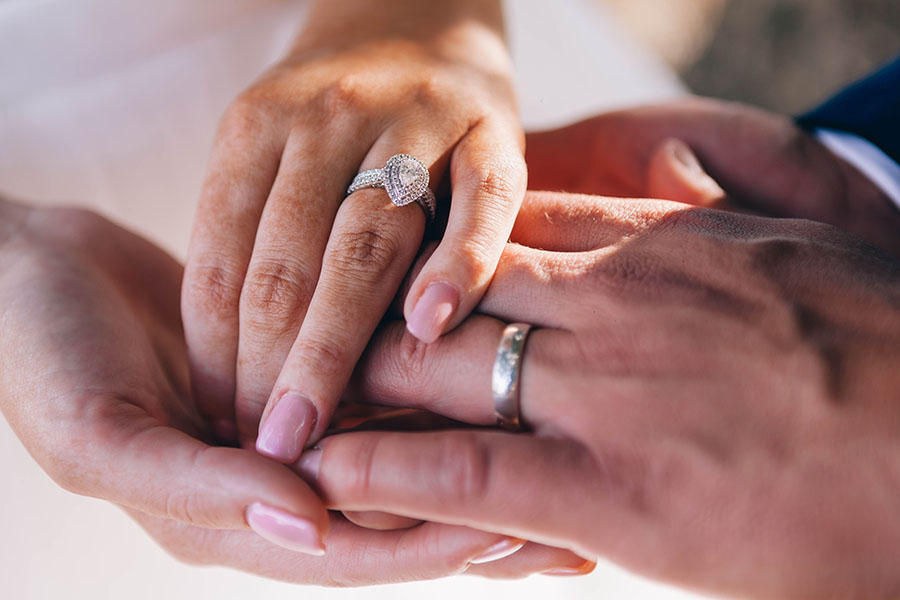
Do you hold traditions dear when it comes to engagement rings? For centuries, specific customs have guided the selection of these timeless symbols of love. Typically, it's expected that the ring features a diamond, often chosen for its durability and brilliance. The tradition of the ring being worn on the fourth finger of the left hand dates back to ancient beliefs that this finger has a direct connection to the heart.

Additionally, many people believe in spending two to three months' salary on the ring, while others prefer to choose a ring that reflects their partner's personal style and preferences. Let us help you navigate these traditions and find the perfect engagement ring that honours these rules while making it uniquely yours.

Read summary

What traditions and rules shape engagement ring choices?

When it comes to engagement rings, several traditions have guided couples for centuries. The most enduring rule is including a diamond or precious stone, a tradition dating back to 1477 when Archduke Maximilian presented Mary of Burgundy with a diamond ring. This established diamonds as symbols of eternal love due to their durability and brilliance.

Financial guidelines also influence purchases, with De Beers famously suggesting that rings should cost two months' salary. While traditionally men purchased these rings, modern couples increasingly share this responsibility, reflecting evolving views on relationship equality.

The tradition of wearing the ring on the fourth finger of the left hand stems from ancient beliefs about a direct connection to the heart, though practices vary across religions. Islam has restrictions on engagement rings with religious symbolism, Judaism follows different gift traditions, while Buddhist and Hindu practices have been influenced by Western customs.
Read more below
engagement ring

5 Questions to Find Her Perfect Engagement Ring

Are you planning to propose? Finding the right engagement ring is a defining step. Every ring is handcrafted in Antwerp from the finest materials by skilled artisans. Discover what engagement ring fits her personality.

Take the quiz

.

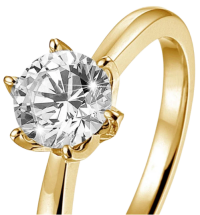
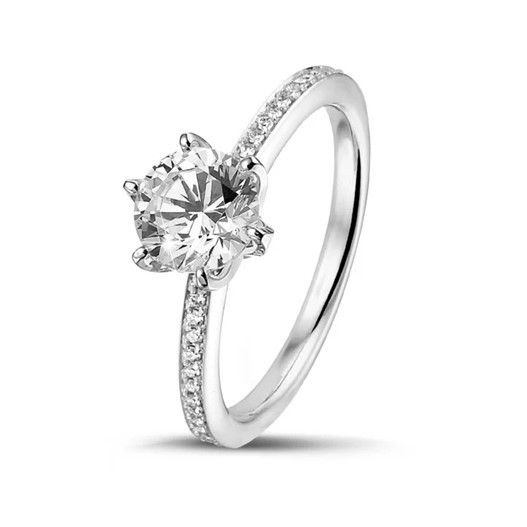
a round diamond solitaire ring with six prongs and side stones, showcasing the importance of precious stones in engagement rings

What are some of the most common rules for engagement rings?

Always including a precious stone

Never has an engagement ring been complete without a precious stone. This tradition dates back to 1477 when Mary of Burgundy received a stunning diamond engagement ring from Archduke Maximilian of Austria. This moment not only marked the beginning of a new era for engagement traditions but also set the standard for couples for centuries to come.

The diamond, with its unparalleled brilliance and durability, symbolises eternal love and commitment. Over the years, this sparkling gem has become a quintessential part of proposals, representing the strength and resilience of a relationship.

The price rule for an engagement ring by De Beers

The largest diamond corporation in the world, De Beers, has not only led the way in the diamond industry but also shaped cultural expectations around love and commitment. In the previous century, they introduced a groundbreaking idea through their advertisements: the notion that an engagement ring should cost two months' salary.

This clever marketing strategy turned the diamond ring into a symbol of devotion and financial commitment, forever altering how couples approach one of life's most significant milestones. As a result, many have felt the pressure to adhere to this unwritten rule, intertwining romance with the value of a precious stone.

The engagement ring being bought by the man

Another traditional rule is that the engagement ring must be purchased by the man. However, as society evolves, we’re witnessing an intriguing shift in this custom. More couples are embracing the idea of sharing the responsibility, with women choosing their own rings or even purchasing them for their partners.

This change not only reflects a more modern approach to relationships but also symbolises a partnership built on equality and mutual understanding. With each ring exchanged, stories of love, commitment, and shared dreams unfold, showcasing the unique journey each couple embarks on together

The significance of the finger it is worn on

The tradition of wearing the engagement ring on the fourth finger of the left hand is rooted in the ancient belief that this finger houses the "vena amoris" or "vein of love," which is said to connect directly to the heart.

However, some people choose to wear their rings on different fingers, like the thumb or index finger, for personal or cultural reasons. Explore the significance of which finger you wear it on.

What about second engagements?

In actual fact, the same engagement ring rules apply to a 2nd marriage proposal as with a 1st. There’s no need to downplay, or even overdo overplay, your proposal (and ring) because it's your 2nd time. Each relationship is unique and accordingly deserves a perfect proposal. Although, the advantage is that you will probably be better informed. You have most likely got a better idea of your budget for the ring, or how many diamond carats you would like.

Read more on ring etiquette for second engagements.

Do engagement ring rules differ across religions?

When engagement ring rules are spoken about in the western world, many might spontaneously think about a Christian wedding. But there are countless other religions and faiths. Here are their rules.

Islam

Wearing an engagement ring is forbidden in Islam. Although, that does deserve a footnote. An engagement ring is forbidden if a superstitious or Christian significance is attached to it. Referrals to symbols of other religions are not permitted in Islam.

If a man subsequently gives his partner a ring to celebrate her consent, this needn't necessarily be an engagement ring.  Rather, it is an expression of his love.

But what does this ban entail for our multicultural society with mixed faiths within a marriage? According to the Koran, an Islamic woman may not marry a Christian man.  But the other way round is, however. Best to keep the church or mosque midway then? Choose an engagement bracelet as an alternative to an engagement ring.

Judaism

According to the strict rules of Judaism, an engagement ring isn't really permitted. A Jewish engagement traditionally involves several gifts. Both the man and woman give each other gifts.  Jewellery is of course an obvious choice of gift to celebrate the engagement. But not a ring. A ring, in whatever form, over-epitomises matrimony. Once the wedding has taken place, the Jewish man can give his partner an 'engagement ring'.

Buddhism and Hinduism

The eastern faiths of Buddhism and Hinduism do not recognise western engagement ring customs and rules. Although it does depend on how traditional the people concerned are.  Under the influence of the West, a Buddhist man can certainly buy his partner an engagement ring. In Hinduism, toe rings are more commonplace, although a ring finger is also always possible.

Find the perfect traditional engagement ring with BAUNAT

Are you still on a quest for the perfect ring for your proposal? Whether selecting a traditional diamond or exploring tailor-made engagement rings, BAUNAT empowers couples to transcend conventional boundaries while honouring the storied legacy of love.

Explore the timeless elegance and artistic creation of traditional engagement rings at BAUNAT, where every ring tells a story beyond words.
  • Fabienne Rauw

  • BAUNAT Antwerp
  • Fabienne, manager of the German market is able to guide every client with finding the right jewel. She takes care of most of the German orders, but also takes other task on her plate. Thanks to her six  years of experience at BAUNAT she acquainted well with the product and the marketing around it. Her degree in PR ensures that BAUNAT is well presented across all media channels. For anyone looking into a new investment opportunity, Fabienne is the perfect guide in this process. No question will be left unanswered, and she will help you every step of the way.

Fabienne, manager of the German market is able to guide every client with finding the right jewel. She takes care of most of the German orders, but also takes other task on her plate. Thanks to her six  years of experience at BAUNAT she acquainted well with the product and the marketing around it. Her degree in PR ensures that BAUNAT is well presented across all media channels. For anyone looking into a new investment opportunity, Fabienne is the perfect guide in this process. No question will be left unanswered, and she will help you every step of the way.