



Features:

Share on:

How diamonds are cut: let’s dive into the world of diamond cutting

Diamonds, often regarded as symbols of luxury and timeless beauty, owe much of their allure to the art of diamond cutting. At BAUNAT, we understand that each diamond is not just a stone but a masterpiece born from meticulous craftsmanship. In this article, we invite you to explore the intricate process that transforms rough gemstones into dazzling jewels, capturing the essence of elegance and precision.

Read summary

How Does a Master Craftsman Transform a Rough Diamond into a Dazzling Gem?

The journey from rough stone to sparkling diamond is an intricate art form combining ancient tradition with modern precision. Diamond cutting begins with meticulous planning to maximize brilliance and value, sometimes taking up to a year. The process continues through cleaving and sawing along natural fracture lines, followed by girdling to create a rough round shape.

The true magic happens during faceting, where cutters strategically create faces that enhance brilliance, fire, and scintillation. After polishing to perfection, each diamond undergoes rigorous grading of its cut quality and symmetry, with top grades commanding significantly higher value.

While originating in India, diamond cutting was refined in Europe, with Belgium becoming the global diamond capital. Today, various cuts exist beyond the popular brilliant—including princess, emerald, heart, and oval—each reflecting different personalities and styles while showcasing the remarkable transformation that turns nature's creation into a timeless treasure.

 .

What is a diamond cut?

Before we immerse ourselves in the cutting process, it's essential to understand what "diamond cut" truly signifies. More than just shape, the cut determines a diamond's ability to reflect light — its brilliance, fire, and scintillation. A well-cut diamond is a testament to both nature's wonders and human ingenuity, showcasing the perfect harmony between raw material and expert craftsmanship.

The diamond cutting process: a step-by-step overview

The process of cutting a diamond is intricate and requires a high level of craftsmanship and precision. This guide breaks down the entire process, from the rough gemstone to the finished, sparkling diamond.

  1. Planning - Meticulous analysis and selection of the optimal cut for brilliance and value.

  2. Cleaving and sawing - Careful separation of the diamond into smaller pieces based on predetermined fracture lines.

  3. Girdling and bruting - Shaping the diamond into a rough round form for faceting.

  4. Faceting - Cutting and polishing each facet to enhance the diamond's brilliance and light interaction.

  5. Polishing - Final polishing to ensure maximum light reflection and overall sparkle.

  6. Grading the Diamond cut - Assessment of cut quality in a gemmological laboratory using advanced technology.

  7. Certification - Obtaining a certificate detailing the diamond's characteristics, ensuring transparency and authenticity.

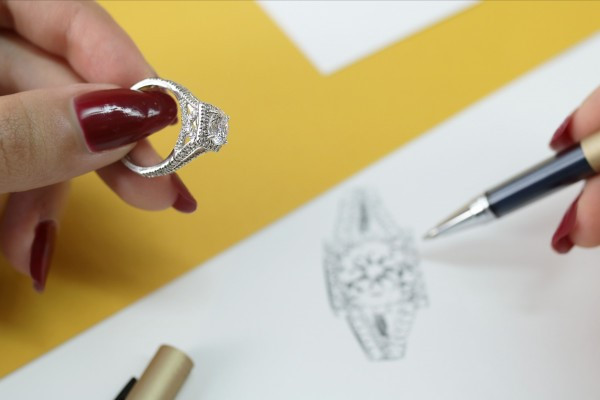
A woman holding a ring while drawing a design

1. Planning

The cutting process begins with detailed planning, which can sometimes last up to a year. The goal is to maximise carat retention while achieving the best possible brilliance and value. During this phase, experts use advanced technology to study the diamond’s internal characteristics and determine the most suitable cut. The shape selected will affect both the appearance and the ultimate value of the diamond.

2. Cleaving and sawing

Once the planning phase is complete, the cutter cleaves the diamond, a process that involves separating the rough diamond into smaller, more manageable pieces. Cleaving is typically done along predetermined fracture lines, using either a mechanical saw or laser. This step is critical, as cutting along incorrect lines can cause the diamond to crumble.

3. Girdling and bruting

After cleaving, the diamond undergoes girdling and bruting, where the diamond is shaped into a rough round form. This is essential for further faceting, as it establishes the basic outline. In this stage, two diamonds can be ground against each other, or a laser is used to create precise, smooth edges. This is when the stone begins to resemble the polished diamond seen in jewellery.

4. Faceting

Once the diamond has been shaped, it is ready for faceting, a crucial step that enhances its brilliance. The stone's facets are carefully cut and polished to allow light to pass through and create scintillation. There are three main elements evaluated in the cut quality:

  • Brilliance: Reflection of white light.

  • Fire: Flashes of colour due to light refraction.

  • Scintillation: Flashes of light when the diamond moves.

5. Polishing

After faceting, the diamond is polished to perfection, ensuring that each facet reflects the maximum amount of light. This is essential to achieve the diamond's brilliance and overall sparkle.

6. Grading the diamond cut

Once cut and polished, the diamond undergoes grading in a gemmological laboratory by experts using special anti-vibration technology and extremely high magnification. Here, experts measure cut quality using the following grades:

  • Triple Excellent: Reflects the maximum amount of light.

  • Excellent: Nearly perfect light reflection.

  • Very Good: Reflects most light and is more affordable than "Excellent" cuts.

  • Good: Reflects a fair amount of light.

  • Fair: Basic reflection.

  • Poor: Minimal light reflection.
a gemmological laboratory expert from the GIA grading the diamond cut

7. Grading the diamond symmetry

Beside the 4C’s, symmetry is an attribute that can also impact the value of your diamond. The symmetry refers to the facets. For example, the culet must be in the middle of the table, the surfaces must be cut to equal size and the diamond’s facets must be similarly shaped.
A culet is the point at the base of a gemstone, that is either polished or not, to create an extra facet. Vital is that this is cut by a craftsman as this will ensure the degree of light to be let through. A culet is often cut into a point, to make the diamond sturdier.

The importance of symmetry in terms of a diamond’s value varies in line with its style and cut. With a heart or pear-shaped cut it is trickier to attain a fully symmetrical cut.

Diamond experts examine these small details in order to grade the diamond’s symmetry, ranging from poor to excellent:

  • Poor (substandard): blemishes discernible with the naked eye.

  • Fair (acceptable): blemishes are discernible with a 10x magnifier and sometimes with the naked eye.

  • Good (good): blemishes hardly discernible with a 10x magnifier.

  • Very good (very good): blemishes are really hard to discern with a 10x magnifier.

  • Excellent (perfect): no discernible blemishes with a 10x magnifier.

A brilliant graded as ‘excellent’ can potentially be 15% more valuable than one a category below it. Symmetry is vitally important with round diamonds with a clarity of VVS2 upwards. Discernible blemishes would tarnish the clarity of a pure gemstone. Besides its higher value, a symmetrical diamond reflects light better. That yields an opulent look & feel to your ring or your diamond studs.

8. Certification

Once the diamond has been graded, it receives a certificate outlining its characteristics, including cut, clarity, colour, and carat (the 4 C's). This certificate provides transparency for buyers and ensures the authenticity and value of the diamond.

Once the quality has been approved for introduction onto the market, an evaluation report is drawn up. Only cut diamonds with a certificate can be manipulated into pieces of jewellery or be put on sale as an investment diamond. With such a certificate the jewellery or gemstone can be sold on in good faith. Should the standard quality criteria not be met, the cutter has to facet and polish the diamond again.

The rich history of diamond cutting

India is purported to be the first country where diamonds were purposefully mined for trade. A 4th century B.C. document, the Artha Castra, specified taxes on gemstones. Indeed, until 1730 India was the only country to export diamonds. The raw material was subsequently also mined in, among other places, Brazil and South Africa.

The oldest reference to diamond may derive from India, but diamond cutting was pioneered in Europe. A diamond cutting guild was established in Nürnberg, Germany in 1357. These diamond cutters concentrated on cut specifications, on how a rough gemstone was to be cut. The first to be cut was the table of the diamond, to consequently be set into jewellery pieces.

But, the real forefathers of beautifully cut diamonds as we know and love them today, were the Belgians. In 1456 Bruges-based, Lodewijk van Bercken, kickstarted the modern-day diamond cutting process. He discovered that diamonds are best cut using their own diamond dust. You see, other materials simply aren’t capable of cutting the hardest material in the world.

As such, Bruges became the diamond capital of the world, until port trade in the 16th century superseded it. After this, Antwerp became the diamond capital. To this day the city upholds its global reputation with pride. In the 17th century, one of its inhabitants, Marcel Tolkowsky, made the city worthy of its name:  he devised a scientific formula to be the first to cut a diamond in 58 facets, known today as the round brilliant cut.
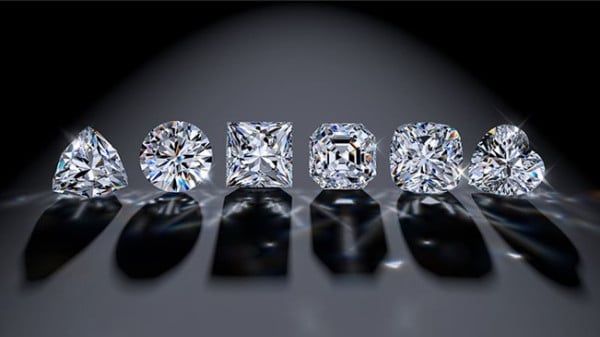
A row of various diamond cuts displayed on a sleek black background, showcasing their distinctive brilliance and elegance.

New trends in diamond cutting: robot cutting

What types of cuts for diamonds do there exist?

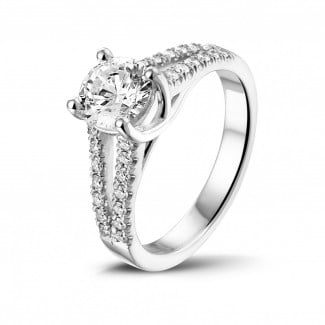
1.00 carat solitaire diamond ring in white gold with side diamonds

The brilliant

The most popular diamond cut is the brilliant. A staggering 95% of all diamonds are cut into a brilliant. This cut underwent  quite some changes before it acquired its final shape in 1919. The 57 or 58 facets add intense scintillation and considerable fire, making this the most lustrous of diamond shapes.

If you can picture your beloved pulling out a gold ring with a brilliant when popping the question, then your style is timeless and elegant with a traditional twist.
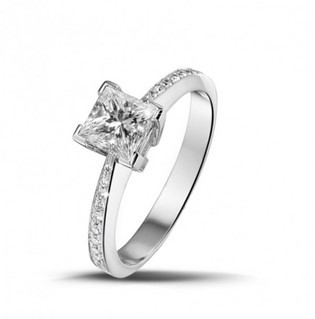
1.00 carat solitaire ring in white gold with princess diamond and side diamonds

The princess cut

The third most popular diamond shape is the romantic princess cut, also known as the square version of the brilliant. This shape scintillates beautifully too.

Diamond cutters are rather keen on this diamond cut, as a staggering 80-90% of the gemstone can be retained. That’s a significant amount, given that on average with other cuts retention equates to around 50%.

This diamond cut is ideal for women who like a touch of the traditional in their jewellery, whilst looking to attain a modern, distinctive style.
An emerald cut diamond displayed elegantly on a pristine white surface, showcasing its clarity and brilliance

The emerald cut

When you hear ‘emerald’ you’ll most likely think of the green gemstone. But ‘emerald cut’ is also a geometrical diamond cut.

Yet, there is a link nonetheless: the shape was initially used for the coloured gemstones, and only used for diamonds later on.
The square diamond shape has rounded corners, and a rounded pavilion, by contrast to the sharper angles of the princess cut. The shape is also known as the ‘step cut’ because the large open facets bring to mind stair treads.

This diamond cut is ideal for women who love glamour in their lives, and who would call themselves daring. This diamond is also popular as it has a vintage appearance, with a nod to the Art Deco style of the 1920s and 30s.
A heart-shaped diamond displayed on a pristine white background, showcasing its brilliance and unique cut

The heart shape

A heart is the ultimate symbol of love. As such, this diamond shape is a popular Valentine’s or Mother’s Day gift, scintillating beautifully in a ring or pendant.

The heart shape is sometimes compared to two pear-shaped diamonds. The heart’s two curves have to be cut in perfect symmetry in order to create scintillation. A skill that only the most experienced cutters have mastered.

The shape makes for a super romantic proposal. If your partner loves a touch of romance, give her a heart-shaped engagement ring.
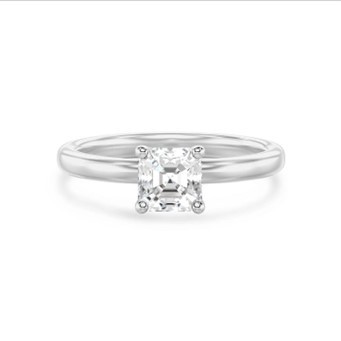
An elegant Asscher cut diamond is displayed prominently, showcasing its exquisite facets and clarity.

The Asscher cut

The Asscher is a square diamond shape that in terms of style lies somewhere between the step emerald and the square cushion with rounded corners. The specific dimensions ensure significant fire and scintillation. Simultaneously, the table is very flat, meaning inclusions or flaws will be a little more noticeable. A VS2 diamond is recommended for this type of diamond cut.

This shape was particularly popular in the 1920s, making it the perfect choice for women who love a touch of Art Deco in their jewellery, but who also wish to draw attention to a diamond cut that is a little rarer nowadays.
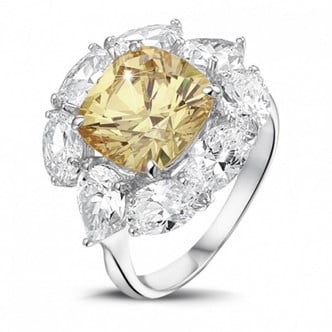
A stunning yellow diamond ring featuring a cushion cut center stone surrounded by sparkling white diamonds.

The cushion cut

The cushion diamond has a rounded square shape, and as the name suggests, looks like a cushion. This cut is available in different length to width ratios; from a symmetrical 1:1 square to a more rectangular 1:3 diamond. The stone is cut into large facets meaning it lets significant light through.

The cushion cut diamond exudes regal elegance. Many Hollywood stars have been proposed to with a cushion cut diamond engagement ring. This cut is perfect for women who adore the well-groomed, gracious look.
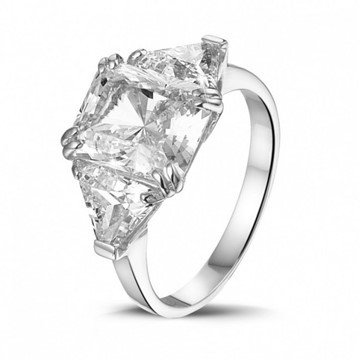
Ring in white gold with radiant diamond and triangle diamonds

The radiant cut

A radiant cut diamond has a square or rectangular shape with slightly rounded corners. The cut makes the diamond appear bigger than it actually is; it follows the clean lines of an emerald cut and scintillates nearly as much as a brilliant.

To ensure all attributes come fully to the fore, diamonds are designated a colour rating of H, G or higher. The scintillation emphasises the colour and clarity, so you’ll need a qualitative gemstone as the centrepiece. Coloured diamonds are also eminently suitable to be cut into a radiant.

This shape is perfect for women who like to flaunt scintillating jewellery, and who are self-assured and vivacious.
1.00Ct halo ring in white gold with oval diamond

The oval cut

The oval diamond can be described as a combination of a round and pear-shaped diamond. The oval diamond was designed as recently as 1960.  One of the best-known oval gemstones is the Pink Star, the most expensive diamond in the world, which was sold at auction for an eye-watering amount of 70 million dollars.

The oval cut on a diamond ring is perfect for women with small hands. Its long shape and scintillation help make the fingers appear longer. The symmetrical gemstone expresses the wearer’s creative and innovative character.
Elegant white gold diamond cluster ring featuring marquise cut white diamonds, showcasing a luxurious and sophisticated design.

The marquise

The marquise diamond cut is a long, thin diamond with pointed ends. The shape was created at the behest of the French king, Louis XV. The gemstone was to look like his mistress’ lips, the marquise of Pompadour, which, of course, explains the name. The marquise shape is more popular with coloured gemstones than colourless diamonds.

Women who wear a marquise cut ring are elegant and social. Moreover, its shape slims the fingers.
Two elegant pendants featuring pear-shaped diamonds, showcasing their exquisite brilliance and refined design.

The pear-shaped diamond

Just as the marquise, the pear-shaped diamond is long, but has just a single pointed base. A few synonyms are the pendeloque, tear or raindrop diamond.

According to the diamond trade, the pointed end must point towards the fingertips. In this way you can make your fingers seem longer and thinner. The pear-shaped diamond looks stunning in a pendant or pair of earrings, when the tear ‘hangs’ (so is attached to the chain at the pointed end).

This diamond shape is popular among women who aren’t looking for a run of the mill diamond, who like to do their own spontaneous thing. This shape is also hugely popular set in a pair of earrings, as they suit all face shapes.
Two oval-shaped cabochon cut emerald stones displayed side by side, showcasing their rich green colour and smooth surface.

The cabochon

Cabochon is a relatively traditional cutting technique whereby the gemstone is polished at the top into a beautifully smooth rounded surface.

Thus giving the jewellery an exceptionally timeless, vintage look. Depending on your personal taste, you can have the dome made higher, rounder or flatter.

Cabochons are often used with coloured gemstones as the technique emphasises the colour. But the cabochon shape is also frequently used with fragile gemstones as this is safer for the stone itself.

A cabochon is easy to combine with a range of jewellery, and can create both a designer or vintage look.
1.50 carat ring in yellow gold with round and baguette diamonds

The baguette

The baguette diamond is long and square in shape and is cut with 14 facets. The cut derives its name from French bread, which with a little imagination, it brings to mind.

In particular, this cut emphasises the diamond’s clarity over its scintillation. This is why it is often used for side stones rather than a solitaire, central diamond.
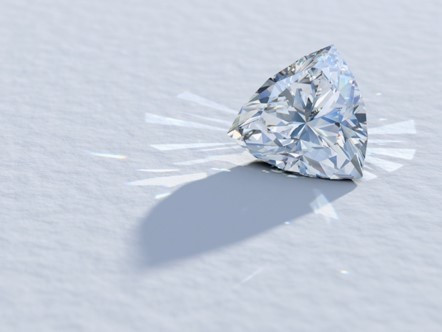
A trillion cut diamond glistens on a pristine white surface, showcasing its brilliance and intricate facets.

The trillion cut

The trillion cut and is cut into three equal length sides. Likewise, this was designed to maximise yield during the cutting process of the 50 facets.

The sides of the diamond are often a little rounded in order to create a softer look. The trilliant is hardly ever used as a solitaire diamond, rather more as a side stone.

The craftsmanship BAUNAT offers

At BAUNAT, we pride ourselves on delivering exceptional craftsmanship that turns every diamond into a radiant symbol of elegance and quality. Each step of the diamond cutting process — from the initial planning to the final certification — is an art form that requires precision, dedication, and expertise.

Our diamond jewellery is not only visually stunning but is crafted with a deep understanding of how to maximise both beauty and value. By embracing modern technology alongside centuries-old techniques, we ensure that each diamond sparkles with unmatched brilliance and stands as a testament to our commitment to excellence.
.
.
  • Fabienne Rauw

  • BAUNAT Antwerp
  • Fabienne, manager of the German market is able to guide every client with finding the right jewel. She takes care of most of the German orders, but also takes other task on her plate. Thanks to her six  years of experience at BAUNAT she acquainted well with the product and the marketing around it. Her degree in PR ensures that BAUNAT is well presented across all media channels. For anyone looking into a new investment opportunity, Fabienne is the perfect guide in this process. No question will be left unanswered, and she will help you every step of the way.

Fabienne, manager of the German market is able to guide every client with finding the right jewel. She takes care of most of the German orders, but also takes other task on her plate. Thanks to her six  years of experience at BAUNAT she acquainted well with the product and the marketing around it. Her degree in PR ensures that BAUNAT is well presented across all media channels. For anyone looking into a new investment opportunity, Fabienne is the perfect guide in this process. No question will be left unanswered, and she will help you every step of the way.