







Features:
-
Category:
-
Posted at:
-
Author:
- Sofie Kuppens
-
BAUNAT Antwerp
-


-
Reading time:9 minutes
In this article:
- What sets the marquise cut diamond apart?
- Marquise cut parameters and how to minimise the bow‑tie
- Protecting the pointed tips: durability and setting guidance
- The Marquise cut and the Diamond prices evolution
- BAUNAT – Balancing Quality and Efficiency
- How to customise your marquise engagement ring with BAUNAT
- Want to delve deeper into our range of engagement rings?
Unveiling the Elegance: The Unmatched Allure of Marquise Engagement Rings
With roots steeped in royal lore, the Marquise cut diamond has been a symbol of refinement and elegance. This captivating cut, which allegedly owes its existence to Louis XV of France, promises to add instant fascination and drama to any engagement ring.
Read summary
What makes marquise engagement rings so distinctively elegant?
Marquise cut diamonds, with their boat-like shape and royal heritage dating back to Louis XV of France, offer a unique blend of history and elegance for engagement rings. Their elongated form creates the illusion of longer, more slender fingers while their 57 facets provide brilliance comparable to round brilliant cuts.
When selecting a marquise diamond, careful consideration is important as their large table makes inclusions more visible, and perfect symmetry is crucial to avoid the "bowtie effect" (a dark area resembling a bow tie) that can appear in this cut.
These distinctive diamonds can be showcased in various settings - from classic solitaires highlighting their unique shape to halo designs that enhance their brilliance with surrounding smaller diamonds. BAUNAT offers expert guidance to help customers find high-quality marquise diamonds that match their preferences while considering current market trends.

5 Questions to Find Her Perfect Engagement Ring
Are you planning to propose? Finding the right engagement ring is a defining step. Every ring is handcrafted in Antwerp from the finest materials by skilled artisans. Discover what engagement ring fits her personality.
Most viewed diamond jewels
-
![1.00 carat solitaire cluster ring in white gold with marquise diamond]() BestsellerNew1.00 carat solitaire cluster ring in white gold with marquise diamondFrom € 4.622,20 (incl. 21% VAT)
BestsellerNew1.00 carat solitaire cluster ring in white gold with marquise diamondFrom € 4.622,20 (incl. 21% VAT) -
![1.00Ct solitaire ring in white gold with Marquise diamond]() Bestseller1.00Ct solitaire ring in white gold with Marquise diamondFrom € 4.186,60 (incl. 21% VAT)
Bestseller1.00Ct solitaire ring in white gold with Marquise diamondFrom € 4.186,60 (incl. 21% VAT) -
![1.00Ct halo ring in white gold with Marquise diamond]() Bestseller1.00Ct halo ring in white gold with Marquise diamondFrom € 5.215,10 (incl. 21% VAT)
Bestseller1.00Ct halo ring in white gold with Marquise diamondFrom € 5.215,10 (incl. 21% VAT) -
![1.00 Ct. solitaire ring in white gold with Marquise diamond and hidden halo]() BestsellerNew1.00 Ct. solitaire ring in white gold with Marquise diamond and hidden haloFrom € 4.924,70 (incl. 21% VAT)
BestsellerNew1.00 Ct. solitaire ring in white gold with Marquise diamond and hidden haloFrom € 4.924,70 (incl. 21% VAT) -
![1.00Ct solitaire ring in white gold with Marquise diamond]() Bestseller1.00Ct solitaire ring in white gold with Marquise diamondFrom € 4.694,80 (incl. 21% VAT)
Bestseller1.00Ct solitaire ring in white gold with Marquise diamondFrom € 4.694,80 (incl. 21% VAT)


.
What sets the marquise cut diamond apart?
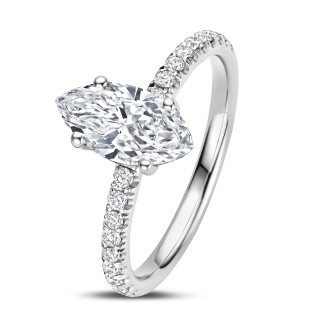
Despite its unique shape, the Marquise cut, with its 57 facets, shares a striking similarity with the conventional round brilliant-cut diamond. The brilliance and fire of a Marquise cut diamond are truly spectacular, and its elongated shape flatters the finger, creating an illusion of length.
Marquise cut parameters and how to minimise the bow‑tie
Length-to-width ratio
The marquise’s look depends heavily on its length-to-width (L:W) ratio. For a classic, elegant marquise that flatters the finger without looking overly narrow, aim for an L:W between 1.75 and 2.00. Wider marquises (around 1.60–1.75) read fuller but can seem squatter, while very elongated stones (2.00–2.25) emphasise length and may show a stronger bow‑tie. These are aesthetic trade-offs; ask to see the stone from several angles to confirm the appearance.Depth and table percentages
Depth and table percentages influence how light returns from the pavilion and crown, and thus affect contrast patterns including the bow‑tie. Practical ranges to consider are:- Depth: roughly 58% to 65%
- Table: roughly 52% to 65%
Pavilion facets, French tip and light return
The number and alignment of pavilion facets and the presence of a French tip (a slightly faceted or polished rounded tip) change how light reaches the ends of the stone. A well-cut pavilion with aligned main facets improves overall light return and reduces a strong bow‑tie contrast. A correctly executed French tip can soften the visual termination and reduce chipping risk, but it must be done precisely to avoid noticeable light leakage.Practical buyer directives
- Ask for the
- Request clear, well-lit photos from multiple angles and a short video to judge any bow‑tie effect in motion.
- Prefer an L:W of 1.75–2.00 for a balanced look; consider other ratios only with awareness of the trade-offs.
What to ask the seller
- "Can you confirm the L:W, table and depth on the certificate ?"
- "Please provide high-resolution photos from top, side and pavilion views and a short video so I can check for a bow‑tie."
- "How many pavilion mains/facets does this marquise have and is the tip a French tip or a pointed tip?"
Protecting the pointed tips: durability and setting guidance
Key durability checks
- Inspect the girdle at the tips: very thin girdles increase chipping risk, while overly thick girdles can hide weight and make a neat setting harder. A balanced girdle near the tips is preferable.
- Examine the tip finish: a well-formed French tip or secure prong protection reduces vulnerability.
Recommended settings and details
- V-prongs or clip prongs at each tip give direct protection and are a common, elegant solution for marquise rings.
- A partial or full bezel around the tips adds security for active wearers while keeping the marquise silhouette.
- Avoid tension settings for marquise diamonds; BAUNAT does not offer tension settings because they raise the risk of the stone loosening at vulnerable points.
Dos and don'ts for buyers
Do:- Request close-up images of the tips and a side view to see how the stone will sit in a ring.
- Consider settings with reinforced prongs or a bezel for a ring meant for daily wear.
- Assume all prong styles protect tips equally; thin prongs may still leave the point exposed.
- Choose a setting that places undue stress on the stone’s ends.
Checking before purchase
- When inspecting a marquise, confirm girdle consistency and ask whether the chosen setting includes tip reinforcement. These checks protect both the diamond and your purchase in daily life.

The Marquise cut and the Diamond prices evolution
BAUNAT – Balancing Quality and Efficiency
How to customise your marquise engagement ring with BAUNAT
Our customisation process
BAUNAT’s bespoke approach is transparent and collaborative. The typical flow is:- Choose the diamond: select proportions, colour and clarity guided by our specialists and certificate data.
- Choose the setting and metal: pick an 18Kt or higher gold alloy or platinum for lasting durability and the metal tone you prefer.
- Consultation and preview: we review images and, where applicable, provide CAD visuals or renders so you can confirm the design.
- Production and final inspection: production starts once the design is approved, followed by a thorough quality check before delivery.
- Metal choice: 18Kt and higher gold tones or platinum, finished to your preference.
- Setting style: solitaires, halo settings, V-prongs or protective bezels for the tips, and side-stone configurations.
- Side-stone options: tapered baguettes, round brilliants or small melee diamonds alter the ring’s silhouette and perceived size.
Certification and ethical sourcing
Every diamond we offer is independently certified by recognised grading laboratories and must meet our sourcing standards. BAUNAT works only with partners who follow international ethical sourcing practices. Our team verifies certificate details and provenance so you receive an independently graded stone and a clear chain of custody.Next steps
If you are ready to explore custom options, request a consultation with one of our specialists who will walk you through diamond choices, settings and visual previews. This personalised guidance helps align proportions, protection and style so your marquise ring is both beautiful and durable. Want to delve deeper into our range of engagement rings?
Remember to consider the continuing Diamond prices evolution while selecting your diamond. Trust Industry Expert BAUNAT to keep you updated on worthwhile investment choices in the Diamond Market.
-
Sofie Kuppens
-
BAUNAT Antwerp
-
-
“Logistics Champion”, which is the title Sofie was awarded with in 2018, leads and supervises the processing of orders and logistics and closely working together with the BAUNAT order team. She strives to ensure maximum customer satisfaction by keeping our clients up to date in the production process and delivering on-time. To improve her product expertise even further, Sofie completed the Diamond Foundation Course by De Beers, which makes her a true diamond specialist.
Professional experience
BAUNAT Group N.V. - Logistics Champion & Order Team Lead (2016–present)
Sofie supervises processing of bespoke orders and coordinates logistics between production and customer service. She keeps clients informed during production, improves internal workflows to reduce variability in lead times, and helped introduce quality checkpoints that raised order accuracy and client satisfaction.
Customer Service & Production Coordinator, BAUNAT Antwerp (2012–2016)
Coordinated daily activity between ateliers and the orders desk, trained new staff to handle custom requests, and developed procedures for order tracking and client communication that strengthened after‑sales follow‑up.
Retail Sales Advisor, Fine Jewellery Boutique (2009–2012)
Advised clients on high‑end jewellery purchases, gained hands‑on experience with diamond grading basics, and refined consultation skills that inform her current role in bespoke order management.
Diamond Foundation Course, De Beers - Certified Graduate (2020)
Completed professional training in diamond properties and grading to deepen gemstone knowledge used in quality checks and client consultations.
Education & credentials
AP Hogeschool Antwerpen - Degree in Applied Business Management, marketing track. De Beers Diamond Foundation Course - Certified Graduate, 2020. Ongoing in‑house BAUNAT training in bespoke jewellery processes and customer experience.
Selected publications & courses
Diamond Foundation Course, De Beers, provider certification and practical grading sessions. BAUNAT blog articles by Sofie Kuppens on engagement ring selection, diamond care and jewellery trends, published on the BAUNAT site between 2023 and 2025. Internal BAUNAT workshops on order logistics and client communication.
Recent activity & perspectives
Unveiling the importance of Engagement Ring Insurance in the UK - "Insuring an engagement ring is not only about protection, it is about securing the emotional and financial value of a lifelong symbol." (12-07-2024, Gemstones)
Unlocking the Meaning Behind Your Engagement Ring's Gemstone - "A gemstone can carry sentiment and story; choosing the right stone means balancing personal meaning with lasting quality." (11-07-2024, Jewellery)
Mastering the Art of Wearing Asymmetrical Earrings - "Asymmetry offers a contemporary silhouette that allows each ear to tell part of a single, stylish story; the key is proportional balance." (04-07-2024, Earrings)
Choosing the right carat weight for your diamond earrings - "Visual impact depends on setting and cut as much as on carat weight; thoughtful design can maximise perceived sparkle without unnecessary size." (11-09-2024, Jewellery)
“Logistics Champion”, which is the title Sofie was awarded with in 2018, leads and supervises the processing of orders and logistics and closely working together with the BAUNAT order team. She strives to ensure maximum customer satisfaction by keeping our clients up to date in the production process and delivering on-time. To improve her product expertise even further, Sofie completed the Diamond Foundation Course by De Beers, which makes her a true diamond specialist.
Professional experience
BAUNAT Group N.V. - Logistics Champion & Order Team Lead (2016–present)
Sofie supervises processing of bespoke orders and coordinates logistics between production and customer service. She keeps clients informed during production, improves internal workflows to reduce variability in lead times, and helped introduce quality checkpoints that raised order accuracy and client satisfaction.
Customer Service & Production Coordinator, BAUNAT Antwerp (2012–2016)
Coordinated daily activity between ateliers and the orders desk, trained new staff to handle custom requests, and developed procedures for order tracking and client communication that strengthened after‑sales follow‑up.
Retail Sales Advisor, Fine Jewellery Boutique (2009–2012)
Advised clients on high‑end jewellery purchases, gained hands‑on experience with diamond grading basics, and refined consultation skills that inform her current role in bespoke order management.
Diamond Foundation Course, De Beers - Certified Graduate (2020)
Completed professional training in diamond properties and grading to deepen gemstone knowledge used in quality checks and client consultations.
Education & credentials
AP Hogeschool Antwerpen - Degree in Applied Business Management, marketing track. De Beers Diamond Foundation Course - Certified Graduate, 2020. Ongoing in‑house BAUNAT training in bespoke jewellery processes and customer experience.
Selected publications & courses
Diamond Foundation Course, De Beers, provider certification and practical grading sessions. BAUNAT blog articles by Sofie Kuppens on engagement ring selection, diamond care and jewellery trends, published on the BAUNAT site between 2023 and 2025. Internal BAUNAT workshops on order logistics and client communication.
Recent activity & perspectives
Unveiling the importance of Engagement Ring Insurance in the UK - "Insuring an engagement ring is not only about protection, it is about securing the emotional and financial value of a lifelong symbol." (12-07-2024, Gemstones)
Unlocking the Meaning Behind Your Engagement Ring's Gemstone - "A gemstone can carry sentiment and story; choosing the right stone means balancing personal meaning with lasting quality." (11-07-2024, Jewellery)
Mastering the Art of Wearing Asymmetrical Earrings - "Asymmetry offers a contemporary silhouette that allows each ear to tell part of a single, stylish story; the key is proportional balance." (04-07-2024, Earrings)
Choosing the right carat weight for your diamond earrings - "Visual impact depends on setting and cut as much as on carat weight; thoughtful design can maximise perceived sparkle without unnecessary size." (11-09-2024, Jewellery)