







Features:
-
Category:
-
Posted at:
-
Author:
- Fabienne Rauw
-
BAUNAT Antwerp
-


-
Reading time:11 minutes
In this article:
The Enigmatic Beauty: Van Gogh’s The Starry Night vs. the Starry Night Sapphire
As the world reached the 125th year since the passing of renowned artist Vincent Van Gogh, we at BAUNAT took a moment to appreciate the convergence of art and nature in one of his most revered masterpieces, The Starry Night. We analyzed this against the backdrop of the diamond prices evolution, a topic in which we as industry experts, have notable insight.
Read summary
How do Van Gogh's artistry and nature's craftsmanship intersect in the world of precious gems?
The parallels between Van Gogh's The Starry Night and the 112-carat Starry Night sapphire showcase a fascinating convergence of art and nature. Created in 1889, Van Gogh's masterpiece depicts a turbulent night sky above a peaceful French village, using deep midnight blues and swirling patterns. Similarly, the Starry Night sapphire displays a mesmerizing six-pointed white star that dances across its deep blue surface, created through a rare phenomenon called asterism. This natural gem mirrors the painting's vault-like composition and color palette, demonstrating how nature can rival human artistry. As colored stones gain popularity in the diamond market, BAUNAT recognizes this growing trend, offering natural colored diamonds and gemstones that embody both artistic beauty and investment value. The intersection of art and nature continues to influence the evolution of diamond prices and collecting preferences.
Most viewed diamond jewels
-
![Halo ring in white gold with an oval sapphire]() Halo ring in white gold with an oval sapphireFrom € 9.341,20 (incl. 21% VAT)
Halo ring in white gold with an oval sapphireFrom € 9.341,20 (incl. 21% VAT) -
![Trilogy ring in white gold with a central sapphire and 2 round diamonds]() Trilogy ring in white gold with a central sapphire and 2 round diamondsFrom € 5.069,90 (incl. 21% VAT)
Trilogy ring in white gold with a central sapphire and 2 round diamondsFrom € 5.069,90 (incl. 21% VAT) -
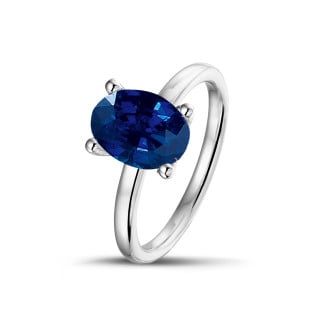
![Ring is white gold with oval sapphire]() Ring is white gold with oval sapphireFrom € 7.018,00 (incl. 21% VAT)
Ring is white gold with oval sapphireFrom € 7.018,00 (incl. 21% VAT) -
![Toi et Moi ring in white gold with round diamond and sapphire]() Toi et Moi ring in white gold with round diamond and sapphireFrom € 5.614,40 (incl. 21% VAT)
Toi et Moi ring in white gold with round diamond and sapphireFrom € 5.614,40 (incl. 21% VAT) -
![Halo solitaire ring in white gold with an oval sapphire and small diamonds]() Halo solitaire ring in white gold with an oval sapphire and small diamondsFrom € 1.836,01 (incl. 21% VAT)
Halo solitaire ring in white gold with an oval sapphire and small diamondsFrom € 1.836,01 (incl. 21% VAT)



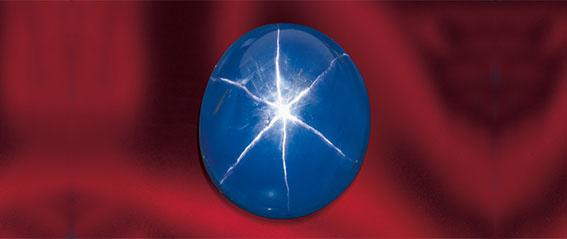
Van Gogh's celebrated The Starry Night was brought to life in 1889, in the quiet heart of southern France. It captures a night sky in tumult over a serene, sleeping French village. A combination of tranquility and activity, this remarkable work amalgamates the calm hills, fields, and village with the agitated, swirling heavens above. Echoing this, we find Mother Nature's rendition of The Starry Night: the 112 carat Starry Night sapphire.
The Starry Night was painted in June 1889 while Van Gogh stayed at Saint-Paul-de-Mausole, an asylum near Saint-Rémy-de-Provence. The painting is part of the permanent collection at the Museum of Modern Art in New York, which helps keep it widely referenced in exhibitions and publications.
Public mentions of the Starry Night sapphire concentrate on its notable 112 carat weight and the bright white star that crosses its deep blue field. Large, well-documented sapphires often move between private collections and auction houses before entering museums or important collections; for serious buyers, records of ownership and any auction history form an important part of provenance assessment.
This sapphire - as vibrant as the midnight blue Van Gogh used - showcases a white six-pointed star that seems to gracefully dance over its surface when viewed from different angles. This phenomena, known as asterism, is a rare spectacle in gemstones. With a bright, white star set against the deep blue of the sapphire, the contrast becomes truly striking. This stone, thus, beautifully mirrors Van Gogh's The Starry Night - in the vault-like shape and the shared color palette.
Van Gogh had an undisputed mastery over color, much like Mother Nature, the true artist. It's remarkable then that blue remains one of the most sought-after hues in gemstones. Colored stones have gained immense popularity in recent times, drawing attention to the diamond market. We invite you to explore this ever-evolving trend with us at BAUNAT, where we offer a variety of natural colored diamonds and gemstones, embodied with our commitment to quality, efficiency, and personalized service.
To conclude, as 'Industry Expert BAUNAT about Diamond Market,' we remind you to consider the evolution of diamond prices in your investments. The Starry Night painting and The Starry Night sapphire remind us of the intertwining journey of art, nature and the world of gemstones, which persists even today. Make your smart investment choice with BAUNAT, guided by our expertise and values.
Starry Night — Palette & Sapphire Hues
A concise palette links Van Gogh's tones to the sapphire's nuances.
- #2F3774 - Deep midnight blue: dominant background swirls and night-sky depth.
- #4C6394 - Turquoise swirl: intermediate blues that catch the painting's layered motion.
- #7EA4B0 - Celadon green: cool highlights and reflections that echo a greenish overtone in some sapphires.
- #CDAF3A - Golden yellow: star and moon accents that punctuate the composition.
- #F2EFD9 - Moon off-white: soft highlights and paint texture details.
These swatches translate the painting's visual language into a practical color set. The Starry Night sapphire, while mainly deep blue, can show a greenish overtone or celadon reflections when light meets its internal structure and surface curve. That mix of deep blue with a hint of green is what visually connects Van Gogh's palette and nature's own starry effect.
Starry Night Sapphire — Assessing the Star
Asterism produces the luminous six-rayed star seen in some cabochon-cut sapphires. It arises from fine, needle-like rutile inclusions aligned along the crystal. When light hits those microscopic needles at the right angle, a distinct white star appears on the dome.
Collectors judge star quality by a few clear criteria. Visibility and contrast come first: the best stones show a bright, well-defined star that stands out from the bodycolor under normal lighting. A weak, washed-out star may only appear under direct light and lacks the presence that makes a specimen memorable. Centering also matters - a star that sits on the dome's apex reads as balanced, while an off-center star can make the cabochon look asymmetrical.
Ray straightness and sharpness affect how refined the effect appears. Top examples have straight, evenly tapered rays with crisp edges; wavy or diffuse rays point to uneven rutile alignment or internal cloudiness. Symmetry is important too: a true six-rayed star has even spacing and similar ray lengths. When these elements come together, the star moves smoothly across the surface as the gem or light source is rotated, creating a sense of motion.
Applied to the 112 carat Starry Night sapphire, these points explain its appeal. A large dome gives room for a prominent, centered star; photographs and in-person accounts report a bright white star against deep blue, with defined rays and steady placement on the cabochon. There, asterism is the gem's main visual feature, recalling the painting's celestial focus.
For inspection: check asterism in both diffuse and directional light, and rotate the cabochon slowly - a quality star will glide rather than jump. View the stone from different distances; a great star works up close and across a room.
Starry Night Sapphire — Specs & Origin
Technical details put a notable sapphire in context. Relevant properties for this material include a Mohs hardness around 9, a refractive index near 1.76–1.77, and a specific gravity typically between 3.98 and 4.06. Sapphires can show weak to moderate pleochroism, so tones may shift slightly with viewing angle; that can influence how the star and bodycolor read. Star sapphires are cut en cabochon with the dome aligned perpendicular to the c-axis to maximize asterism; dome height and orientation directly affect star sharpness.
Historically important sources for gem-quality star sapphires include Sri Lanka, Myanmar and Australia, each producing material with characteristic bodycolors and inclusion patterns. Greenish overtone star sapphires are less common than classic cornflower or deep blues, and that relative rarity increases collector interest when paired with strong asterism and large size. For the 112 carat Starry Night stone, scale, pronounced star quality and an uncommon hue combine to draw attention.
Treatments and disclosure matter in the market. Many sapphires undergo heat treatment to improve color and clarity; for star stones, clear disclosure of any enhancements and lab reports is standard practice. Request provenance and certification that notes treatments. Transparent documentation supports confident collecting without implying any single origin is superior.
At this weight, corundum's hardness and density make for a durable gem when set correctly, and the cabochon cut is the usual choice to show the star. Its mix of scale, visible asterism and distinctive hue is what invites comparison - in spirit - with Van Gogh's nocturne.
-
Fabienne Rauw
-
BAUNAT Antwerp
-
-
Fabienne, manager of the German market is able to guide every client with finding the right jewel. She takes care of most of the German orders, but also takes other task on her plate. Thanks to her six years of experience at BAUNAT she acquainted well with the product and the marketing around it. Her degree in PR ensures that BAUNAT is well presented across all media channels. For anyone looking into a new investment opportunity, Fabienne is the perfect guide in this process. No question will be left unanswered, and she will help you every step of the way.
Selected Bespoke Projects
• Eternal Bloom bespoke engagement concept - Role: project lead for client briefing and prototype coordination. Fabienne translated personal design references into a 3D-printed prototype, supervised stone selection and ensured the finished piece matched the client’s vision and comfort preferences.
• Personalized anniversary necklace - Role: design coordinator and quality overseer. She managed the custom design process from the initial sketch to final polishing, liaising between client and workshop to preserve proportions and finish.
• Reimagined heirloom ring restoration and redesign - Role: client consultant and technical coordinator. Fabienne guided the client through options to modernize setting details while keeping sentimental elements, delivering a wearable result that respected the original piece.
Her hands-on involvement in bespoke commissions ensures each custom order has a clear brief, careful prototype review and close follow-up with the workshop, so clients receive a tailored jewel that meets both aesthetic and practical expectations.
Professional enquiries
For speaking engagements, press requests or research collaborations, please send your message to BAUNAT’s communications team with the subject line: "Fabienne Rauw - Professional Enquiry." Include a brief description of the request and any relevant dates or documents. The communications team will route enquiries to Fabienne and provide guidance on next steps.
Fabienne, manager of the German market is able to guide every client with finding the right jewel. She takes care of most of the German orders, but also takes other task on her plate. Thanks to her six years of experience at BAUNAT she acquainted well with the product and the marketing around it. Her degree in PR ensures that BAUNAT is well presented across all media channels. For anyone looking into a new investment opportunity, Fabienne is the perfect guide in this process. No question will be left unanswered, and she will help you every step of the way.
Selected Bespoke Projects
• Eternal Bloom bespoke engagement concept - Role: project lead for client briefing and prototype coordination. Fabienne translated personal design references into a 3D-printed prototype, supervised stone selection and ensured the finished piece matched the client’s vision and comfort preferences.
• Personalized anniversary necklace - Role: design coordinator and quality overseer. She managed the custom design process from the initial sketch to final polishing, liaising between client and workshop to preserve proportions and finish.
• Reimagined heirloom ring restoration and redesign - Role: client consultant and technical coordinator. Fabienne guided the client through options to modernize setting details while keeping sentimental elements, delivering a wearable result that respected the original piece.
Her hands-on involvement in bespoke commissions ensures each custom order has a clear brief, careful prototype review and close follow-up with the workshop, so clients receive a tailored jewel that meets both aesthetic and practical expectations.
Professional enquiries
For speaking engagements, press requests or research collaborations, please send your message to BAUNAT’s communications team with the subject line: "Fabienne Rauw - Professional Enquiry." Include a brief description of the request and any relevant dates or documents. The communications team will route enquiries to Fabienne and provide guidance on next steps.