







Features:
-
Category:
-
Posted at:
-
Author:
- An Van Puyvelde
-
An Van Puyvelde - Order & Administration Manager
-


-
Reading time:12 minutes
In this article:
Turning a unique engagement ring into an investment - part 1
Part 1 - The emotional advantages
When considering the purchase of an engagement ring, that unique, dream-come-true, timeless diamond ring that will make your fiancé scream of joy, have you considered purchasing a ring containing a diamond that would be considered an investment?
Today we are going to consider the Emotional advantages of buying an engagement ring with a diamond as an investment, we will then also consider the Financial advantages in the second part.
Read summary
How can an engagement ring serve as both a romantic symbol and a smart investment?
When searching for the perfect engagement ring, combining emotional value with investment potential creates a uniquely meaningful purchase. The key emotional advantages center around three main aspects: uniqueness, quality, and trust. Investment-grade diamonds offer exclusive characteristics in color, clarity, and carat weight, setting them apart from standard stones.
Do engagement rings hold value?
Do engagement rings hold value? The short, evidence-based answer is: sometimes. Rings that combine investment-grade diamonds, high-purity metals and verifiable provenance can retain a large portion of their intrinsic value and, in select cases, appreciate relative to general market pricing. Much depends on objective factors such as certified stone characteristics, the reputation of the maker and prevailing demand. At the same time, typical retail transactions include mark-ups for design and service, so many pieces will not recoup full retail price on resale. Authoritative sources note that a diamond’s value is determined by its quality, the terms of sale and market demand; diamonds with clear grading and provenance, supported by recognised laboratory reports, command higher confidence among buyers and therefore stronger resale prices. These exceptional features, when paired with superior craftsmanship and precious metals, create an engagement ring that not only captures the romance of the moment but also holds lasting value.The foundation of such a significant purchase lies in working with a trusted, reputable jeweler who provides traceable, ethical diamonds and expert guidance. A reliable retailer ensures both the emotional satisfaction of finding the perfect ring and the confidence of making a sound investment. Companies like BAUNAT specialize in combining these elements, offering high-quality diamonds, exceptional craftsmanship, and comprehensive customer service.

5 Questions to Find Her Perfect Engagement Ring
Are you planning to propose? Finding the right engagement ring is a defining step. Every ring is handcrafted in Antwerp from the finest materials by skilled artisans. Discover what engagement ring fits her personality.
Most viewed diamond jewels
-
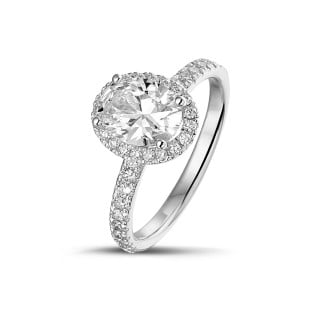
![1.00Ct halo ring in white gold with oval diamond]() Bestseller1.00Ct halo ring in white gold with oval diamondFrom € 5.578,10 (incl. 21% VAT)
Bestseller1.00Ct halo ring in white gold with oval diamondFrom € 5.578,10 (incl. 21% VAT) -
![1.00 carat solitaire cluster ring in white gold with marquise diamond]() BestsellerNew1.00 carat solitaire cluster ring in white gold with marquise diamondFrom € 4.622,20 (incl. 21% VAT)
BestsellerNew1.00 carat solitaire cluster ring in white gold with marquise diamondFrom € 4.622,20 (incl. 21% VAT) -
![0.95 carat diamond rose design ring in white gold]() NewPrincess Delphine0.95 carat diamond rose design ring in white goldFrom € 16.831,10 (incl. 21% VAT)
NewPrincess Delphine0.95 carat diamond rose design ring in white goldFrom € 16.831,10 (incl. 21% VAT) -
![1.00 carat solitaire ring with an asscher cut diamond in white gold]() Bestseller1.00 carat solitaire ring with an asscher cut diamond in white goldFrom € 4.936,80 (incl. 21% VAT)
Bestseller1.00 carat solitaire ring with an asscher cut diamond in white goldFrom € 4.936,80 (incl. 21% VAT) -
![1.00 carat solitaire ring with a cushion diamond and hidden halo in white gold]() BestsellerNew1.00 carat solitaire ring with a cushion diamond and hidden halo in white goldFrom € 4.210,80 (incl. 21% VAT)
BestsellerNew1.00 carat solitaire ring with a cushion diamond and hidden halo in white goldFrom € 4.210,80 (incl. 21% VAT)


Uniqueness
Engagement rings, the one topic that at some point in one’s life, always comes into a conversation, either directly with the love of your life, with the parents, with friends or directly with professional jewellers and designers.
But what does one want when looking for the perfect engagement ring? Uniqueness, indeed that is the most sought after design, a unique engagement ring that will blow your fiancé’s mind away.
When purchasing a ring with a diamond that could be considered an investment, the uniqueness rhymes with exclusive colour, clarity and carat weight.
Quality
Overall, when looking for that one-of-a-kind engagement ring that will provoke all of those emotions related to love such as joy, laughter, tears and screams of happiness, one needs a ring in a precious metal and craftmanship that will perfectly portray the investment diamond.
The quality of the craftmanship is crucial, as a diamond set in a poor design and quality, will not have the same results and lifelong aura as a diamond set in a beautifully crafted ring. This is also a condition for your engagement ring becoming a worthy investment over the long term.
Trust
Trust is another very important emotional component when looking at finding the perfect engagement ring. You need to be able to purchase from a reliable, recognised source, where the primary materials and diamonds are traceable, guaranteeing that the ring and diamonds you are purchasing are genuine, ethical and of the quality expected.
Buyers need the certainty that they are buying from a trustworthy, knowledgeable retailer, diamond dealer or jeweller that gives them honest advice and the quality they are expecting.
At BAUNAT our aim is to provide our customers with the most complete service possible, from in-depth knowledge of stones and jewellery, to the use of the best materials, sourcing directly the most beautiful diamonds as well as using the state-of-the-art craftmanship and designs.
Therefore, should you be looking for an amazing engagement ring with a diamond that could be considered an investment, we at BAUNAT have everything you are looking for and more.
How resale value is determined for diamonds and rings
A ring’s emotional worth is only part of the story when assessing its financial value. Several objective factors influence what a diamond or finished jewel will fetch on the secondary market. Understanding these drivers helps buyers choose pieces that are both meaningful and marketable.
Certification
An independent laboratory report is the most important document for a diamond’s resale value. Reports from reputable labs describe the stone’s cut, color, clarity and carat weight in an objective, reproducible way. When these characteristics are documented on a respected certificate, potential buyers and dealers can compare stones with confidence. Listings accompanied by a GIA report often attract higher bids because the report removes uncertainty about a diamond’s attributes. Always check the issuing laboratory, the exact grades listed and whether the report includes cut grade, fluorescence and plotted clarity.
Metal quality
The precious metal of the mounting contributes to intrinsic and perceived value. Rings crafted in 18Kt gold or higher match the standards expected for investment-grade jewellery, both for their metal content and for market perception. Metal purity affects melt value in certain transactional scenarios and signals quality to prospective buyers. Avoiding lower-karat alternatives helps maintain a consistent market positioning and makes valuation more straightforward.
Market demand and style liquidity
Not all beautiful designs sell equally well on resale. Classic, timeless settings and signature designs from recognised maisons tend to be more liquid; they appeal to a broader pool of buyers and hold value better over time. Highly personalised motifs, short-lived trends or very avant-garde constructions can be harder to re-market. When considering a bespoke commission, weigh how distinctive the aesthetic is against how widely it will be desired by other buyers.
Documentation and provenance
Beyond a lab report, complete documentation preserves value. Important items include the original purchase receipt, any warranty or appraisal documents, the lab certificate itself and, where relevant, documentation attesting to ethical sourcing. Together these papers form a provenance file that reassures buyers and auction houses. Pieces with clear provenance and intact paperwork generally achieve stronger results than equivalent item. sold without records.
Putting it together
A diamond with a respected laboratory certificate, set in 18Kt or higher metal, mounted in a classic or recognisable design and accompanied by full documentation will be easier to value and sell than an equivalent stone lacking these elements. Objective grading, reputable materials and traceable provenance are the practical foundations that help an engagement ring perform on the secondary market.
Resale & Liquidity: How your engagement ring can be converted back to cash
Resale and liquidity describe how readily a piece of jewellery can be converted into cash and at what value. If you see an engagement ring as more than a keepsake, it helps to understand common resale routes and which factors influence marketability. People seek liquidity for life changes, estate matters or simply to realise part of a piece’s value. Being realistic about channels and preparing a ring for resale protects both its emotional and financial worth.
Typical resale channels
The secondary market has several options, each with different outcomes. Auction houses can reach high prices for rare, well-documented pieces, especially with clear provenance and collector interest, but results are variable and fees can be substantial. Private dealers and specialised jewellery buyers are faster and more convenient; they may offer immediate purchase, though offers are often below retail replacement value. Some established jewellers provide trade-in or buyback programmes; these give a straightforward route back to cash but usually apply specific criteria and valuations. Each channel requires trade-offs between speed, net proceeds and certainty - the right choice depends on the stone, documentation and how quickly you need to sell.
Key value drivers for resale
A few objective factors most affect resale outcomes. Provenance and a recognised maker can increase desirability, particularly for documented custom commissions. Third-party certification and clear graded documentation make pricing transparent for buyers; certified stones inspire more confidence and generally attract stronger offers. Rarity matters: unusual colours, high-clarity stones and well-cut, larger carat weights tend to be more marketable. The quality and permanence of the setting and clear hallmarks on the metal also influence buyer trust; a well-made mounting in a recognised precious metal supports resale value. Market demand and prevailing styles play a role, so objectively rare or classic designs often retain value better than strongly trend-driven pieces.
Practical documentation and preservation tips
To maximise resale prospects, keep complete records and preserve the piece in near-original condition. Keep certificates and lab reports, the original sales receipt and any appraisals or condition notes. High-resolution photos from multiple angles and dated images showing the ring being worn help substantiate provenance and condition over time. Store the ring in a protective case and avoid unnecessary resizing or irreversible changes; when work is required, use reputable craftsmen and keep records of repairs. Regular, gentle maintenance to keep the mounting secure is sensible, but major alterations can reduce marketability.
Realistic expectations about resale
An engagement ring combines emotional and monetary value, and resale outcomes vary. Expect offers to reflect wholesale or secondary-market pricing rather than original retail prices. Pieces with clear certification, solid provenance and timeless design typically perform best; undocumented stones, unrecognised makers or heavily altered settings normally attract lower offers. Understanding the different channels and preparing documentation ahead of time improves your options if you ever choose to convert the ring back to cash.
Engagement rings versus other tangible investments
Comparing engagement rings and diamonds to other tangible assets clarifies where they sit in a wider investment landscape. Unlike financial instruments, these items combine emotional use with potential monetary value; knowing relative liquidity, authentication challenges and transaction friction sets realistic expectations.
Diamonds versus gold
Gold is a fungible commodity with global markets, straightforward pricing and high liquidity; selling gold involves little ambiguity about metal content and weight. Diamonds are different: each stone is unique, so grading and verification add complexity. For ease of sale and predictable pricing, gold usually involves less friction. For buyers who value rarity, certification and cut quality, diamonds can offer a different long-term store of value, though they typically require more specialised buyers.
Diamonds versus watches
Fine mechanical watches are collectible and can appreciate, driven by brand, rarity and provenance. Like diamonds, watches need authentication and can command premiums for iconic models and documented history. Watches often benefit from active secondary markets and enthusiast communities, which can improve liquidity for sought-after pieces. Diamonds have advantages in portability and timelessness, while watches combine daily wearability with collectible appeal; the best choice depends on whether the buyer values regular use, brand collectibility or gemstone rarity.
Diamonds versus art
Art markets are subjective and influenced by artist reputation, provenance and gallery representation. Exceptional artworks can achieve high returns at auction, but the market is illiquid and prices can be volatile. Diamonds sit between gold and art: their valuation is more objective than art because of the 4Cs and certification, yet less uniform than gold since individual characteristics matter. For buyers prioritising objective grading and modest transaction sizes, diamonds may be preferable to art; for those targeting outsized appreciation based on cultural trends, art may suit better.
Decision-framework checklist
To decide whether an engagement ring could act as an investment, consider these questions: Is the diamond accompanied by reputable certification and documentation? Does the piece have a classic, durable design rather than a fleeting trend? Is provenance or brand recognition present? Would you prioritise portability and discreet value storage, or seek assets with highly liquid commodity markets? If several checklist items point to certification, rarity and classic design, the ring has a stronger case as a tangible investment. If liquidity and predictable pricing are most important, comparing with gold or other more fungible assets may be wiser.
Don’t miss out on Part 2 which will be dedicated to the financial advantages of buying an investment diamond!
-
An Van Puyvelde
-
An Van Puyvelde - Order & Administration Manager
-
-
An supervises BAUNAT’s order processing and logistics, working closely with the internal order team to ensure a seamless customer experience. She plays a key role in coordinating production timelines and maintaining clear communication with clients throughout the entire process. With a strong focus on precision and reliability, An is dedicated to delivering each piece on time while keeping customers fully informed, contributing to BAUNAT’s high standard of service and customer satisfaction.
An supervises BAUNAT’s order processing and logistics, working closely with the internal order team to ensure a seamless customer experience. She plays a key role in coordinating production timelines and maintaining clear communication with clients throughout the entire process. With a strong focus on precision and reliability, An is dedicated to delivering each piece on time while keeping customers fully informed, contributing to BAUNAT’s high standard of service and customer satisfaction.