







Features:
-
Posted at:
-
Author:
- Stephanie Hesters
-
BAUNAT Antwerp
-


-
Reading time:12 minutes
In this article:
The classic wedding ring: an essential part of the traditional British wedding
Classic wedding rings are at the heart of British wedding traditions, deeply cherished as symbols of love and union. From their timeless elegance to the significance of a white dress, these customs transcend time and borders, becoming integral to the global tapestry of matrimonial celebrations.
Read summary
What makes classic wedding rings a timeless symbol in British weddings?
Classic wedding rings hold a special place in British wedding traditions as enduring symbols of unity and commitment. Traditionally crafted in white gold, these elegant bands feature either white or black diamonds rather than colored gemstones, offering a subtle sparkle that enhances without overwhelming their simple design.
At BAUNAT, couples can personalize their wedding bands by selecting from various cuts (brilliant or princess), styles (eternity or cocktail), and shank designs (regular, hammered, or criss-cross). The choice between traditional or black diamonds allows for either timeless elegance or contemporary sophistication.
British wedding traditions extend beyond rings to include other meaningful customs. Queen Victoria popularized the white wedding dress in 1840, while the "something old, new, borrowed, and blue" tradition symbolizes different aspects of the couple's journey. The first dance, originating from royal balls, continues as a cherished part of wedding celebrations.

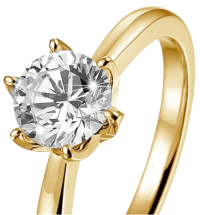
5 Questions to Find Her Perfect Engagement Ring
Are you planning to propose? Finding the right engagement ring is a defining step. Every ring is handcrafted in Antwerp from the finest materials by skilled artisans. Discover what engagement ring fits her personality.
Most viewed diamond jewels
-
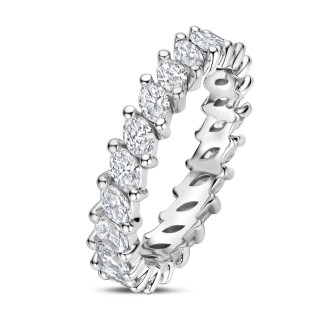
![1.75 carat full-set eternity ring with marquise cut diamonds in white gold]() Bestseller1.75 carat full-set eternity ring with marquise cut diamonds in white goldFrom USD 7.090,00 (excl. VAT)
-
![0.26 carat half-set eternity ring in white gold - matches with all rings from the Fancy Shapes collection]() Bestseller0.26 carat half-set eternity ring in white gold - matches with all rings from the Fancy Shapes collectionFrom USD 2.720,00 (excl. VAT)
-
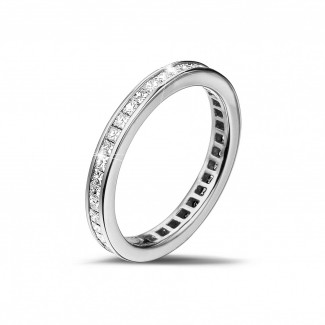
![0.90 carat eternity ring (full set) in white gold with princess diamonds]() Bestseller0.90 carat eternity ring (full set) in white gold with princess diamondsFrom USD 3.700,00 (excl. VAT)
-
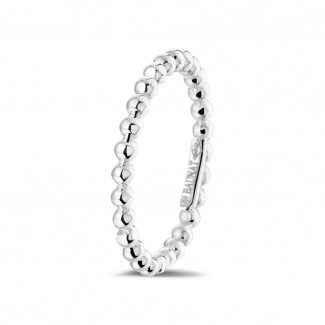
![Stackable beaded ring in white gold]() Stackable beaded ring in white goldFrom USD 1.630,00 (excl. VAT)
-
![0.22 carat half-set eternity ring in white gold - matches with specific rings from the BAUNAT Iconic collection]() Bestseller0.22 carat half-set eternity ring in white gold - matches with specific rings from the BAUNAT Iconic collectionFrom USD 3.000,00 (excl. VAT)


.

What are classic wedding rings, also known as wedding bands?
Imagine slipping on a band adorned with a subtle line of black or white diamonds, each stone carefully set to catch just the right amount of light. This choice offers a refined touch of sparkle, conveying elegance without overpowering the ring's simplicity. The absence of coloured diamonds maintains the classic look while adding a hint of modern sophistication, making these wedding bands both timeless and versatile.
Different styling options for classic wedding bands
- Cut
- Brilliant cut: Known for its timeless sparkle.
- Princess cut: A square shape that adds a modern, angular look.
- Style
- Eternity band: Features diamonds encircling the entire ring for a continuous sparkle.
- Cocktail style: Often larger and bolder, perfect for making a statement.
- Shank design
- Regular shank: Embracing simplicity and tradition, the regular shank design is characterised by its smooth, uninterrupted band.
- Hammered shank: Adds a textured, artisanal touch to the band.
- Criss Cross shank: Intertwined bands that give a unique twist on a classic look.
- Diamond choice:
- Traditional diamonds: Renowned for their brilliance and clarity, traditional diamonds are emblematic of enduring romance. Their unmatched sparkle provides a timeless elegance, making them an ideal choice for those favouring classic sophistication.
- Black diamonds: For those seeking a contemporary twist, black diamonds provide a unique contrast and a modern edge, embodying a mysterious and bold elegance. They are perfect for couples who wish to add a touch of the unexpected to their matrimonial symbol, projecting both strength and individuality.
These options allow you to create a ring that speaks to your personal style.
Practical specs and sizing: choosing the right band size and profile
Width. This is the visible measurement across the top of the ring, usually given in millimetres. Narrow widths, typically 2 to 3 mm, sit discreetly and suit slender fingers or anyone who prefers a subtle look. Medium widths, around 4 mm, are versatile and commonly chosen by couples who want a balance between presence and comfort. Wider bands, 5 mm and above, give a more substantial appearance and are often selected for men’s rings or to match a larger engagement ring.
Depth and thickness. Depth is the height from the inner curve to the outer surface. Thickness is the metal mass of the shank and affects durability and weight. Many classic bands use shallow to medium depth and thickness to stay comfortable while remaining durable.
Profile. The profile describes the ring’s cross-section. Common profiles are flat, comfort-fit (rounded inside for easier wear), and domed (a curved exterior). Flat profiles sit close to the finger and look modern. Domed profiles feel more traditional and softer to the eye. Comfort-fit profiles make daily wear and taking the ring on and off easier.
Practical width and depth guidance
- For a minimal, understated band: choose 2–3 mm with a slim profile. This works well if you plan to stack or pair the band with a delicate engagement ring.
- For an everyday, versatile band: 4 mm is the most commonly chosen width, balancing presence and comfort.
- For a statement or men’s band: 5 mm and above offers a substantial look and pairs well with wider engagement settings.
Lifestyle rules of thumb
- Hands-on or active jobs: choose a narrower width with a rounded comfort-fit profile to reduce catching and improve mobility.
- Frequent hand-washers or those who wear gloves often: a slightly thicker shank increases durability without sacrificing comfort.
- If you plan to stack multiple rings: measure the combined height of all rings and consider slightly narrower band widths so the set sits flush.
Sizing best practices
- Measure finger circumference at room temperature, preferably at the end of the day when fingers are at their largest. Use a soft measuring tape or a printable ring sizer and repeat the measurement a couple of times.
- If your knuckle is noticeably larger than the base of your finger, size for the knuckle and consider a comfort-fit profile to ease passage.
- Wider bands often feel tighter; in those cases, sizing up by a half-size can improve comfort.
- Very wide bands or rings with significant thickness can complicate resizing. Large differences between an engagement ring and wedding band can make later adjustments more complex.
If you need exact millimetre specifications for a particular design or help choosing a profile for daily wear and stacking, consult the product page or speak with a BAUNAT consultant who can provide the precise dimensions for each model.
What else is typical for a traditional British wedding?
As you delve into the elegance and timeless beauty of a traditional British wedding, you'll discover a world where romance and heritage beautifully intertwine, inviting you to partake in a tradition that celebrates love with unmatched sophistication and grace.
The white dress
You may not know this, but the tradition of wearing a white dress actually comes from Great Britain.In the early days, brides and grooms wore the best clothes they owned, and these could be any colour or style. But this changed the day Queen Victoria wore an ivory white wedding gown trimmed with Honiton lace for her wedding to Prince Albert of Saxe-Coburg in 1840. That is when wearing a white wedding dress became fashionable and ‘the thing to do’ for brides, in accordance with the Queen.
British provenance, hallmarks and Welsh gold
A hallmark is an official stamp applied by a national Assay Office that certifies the metal purity of a piece. In the UK, hallmarking has centuries of history and acts as a guarantee that the gold or platinum meets the stated standard. When buying a ring with British provenance, look for the Assay Office mark and the metal fineness mark; together they confirm authenticity and the carat standard declared for the piece.Welsh gold has a special place in British wedding lore. Historically scarce and linked to the royal family, small quantities of Welsh gold have been used in royal wedding rings for generations. That heritage gives Welsh gold symbolic value, often chosen for its story and connection to British tradition rather than for any technical advantage.$
When considering a ring with a British hallmark or Welsh gold provenance, check the markings and provenance information provided by the seller. Hallmarks and clear provenance add assurance about the metal used and its origin, and they enrich the cultural story behind a wedding ring without changing the practical qualities of daily wear.
Old, new, borrowed and blue
We have all heard that on your wedding day, you should wear something old, new, borrowed and blue. Throughout the decades that saying has been heard at weddings across Europe.The actual saying goes as follows: ‘Something old, something new, something borrowed, something blue, and a silver sixpence in her shoe.’ The old refers to the past, the new stands for the future, the borrowed is about the happiness the new husband gives the bride and the blue is against evil. Today, the part regarding the sixpence is not really mentioned anymore but it originally referred to wealth.
The first dance
Last but not least, is the tradition of the first dance. This tradition stems from the grand royal balls that took place centuries ago. Back then, the male guest of honour invited the lady of the house to dance. Once they had danced a couple of minutes, they would then open the floor to all guests and the ball would officially start. This tradition has then become a wedding tradition, where the father of the bride would dance with her, and the groom would dance with his mother. Today, it is often the case where the groom and bride have their first dance and then open the floor to their guests.
Discover our classic wedding ring designs
-
Stephanie Hesters
-
BAUNAT Antwerp
-
-
As the Head of Diamond Buying at BAUNAT, Stephanie has an extensive knowledge of the diamond and the evolution of diamond prices. Thanks to her broad product knowledge gained throughout her years at BAUNAT and the Diamond Foundation Course by De Beers, Stephanie advises our customers interested in the investment side of diamonds to optimize every investment. To support her skills she has a bachelor’s degree in Business Management together with her master’s in Communication.
About Stephanie Hesters (also known as Stephanie Lasters)
Stephanie Hesters, sometimes listed online as Stephanie Lasters, is Head of Diamond Buying at BAUNAT. She manages diamond sourcing and valuation, advises clients on market trends and pricing, and helps those looking for investment-grade stones. She completed the Diamond Foundation Course by De Beers and holds a bachelor’s degree in Business Management and a master’s in Communication.
Selected projects & collaborations
• Eternal Bloom Collection with Princess Delphine of Saxe-Coburg (2026), curator and project lead - guided creative direction and diamond selection for an exclusive collection that blends classical motifs with contemporary craftsmanship.
• Investment Diamonds Advisory Series (2024), author and presenter - developed client-facing guides and presentations on diamond valuation and market dynamics for private buyers and collectors.
• BAUNAT Editorial Features and Product Launches (2022–2025), contributor - worked with design and marketing teams to shape product narratives and ensure technical accuracy in launch materials and editorial content.