







Features:
-
Category:
-
Posted at:
-
Author:
- Kim Wouters
-
BAUNAT Antwerp
-


-
Reading time:18 minutes
In this article:
- What is a pink diamond?
- How to verify a natural pink diamond: certificates and lab reports
- How did pink diamonds come about?
- The value and advantages of a pink diamond
- Market value, famous sales and what to expect to pay
- How do I combine a pink diamond?
- Shape, setting and protective-setting guidance for pink diamonds
- Tailor made pink diamond jewellery at BAUNAT
- Read more about diamonds
- Frequently asked Questions
Why choose a pink diamond over a white one?
When thinking about diamond jewellery a white or colourless precious stone naturally springs to mind. Traditionally, these are the most popular choice of engagement ring or other jewellery. But many might perhaps not know that coloured diamonds sparkle beautifully too. Indeed, the pink diamond is rapidly increasing in popularity. Here we delve briefly into its appeal and how it differs from a white diamond.
Have your pink diamond ring tailor made
Read summary
Why Are Pink Diamonds Becoming a Popular Alternative to White Diamonds?
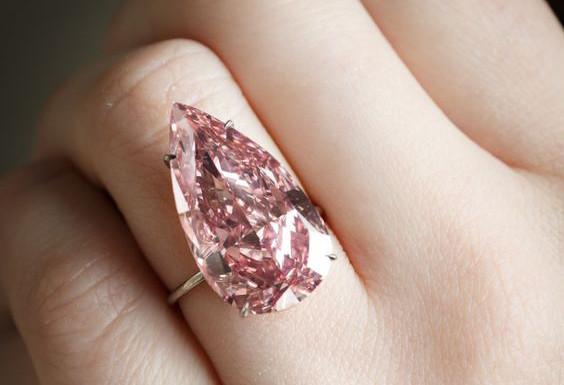
Pink diamonds offer a rare and distinctive option for those seeking something beyond traditional colorless diamonds. These exceptional gems get their delicate pink hue from specific geological forces rather than chemical elements like blue or yellow diamonds. Their extreme rarity—less than 1% of Australia's Argyle mine production—makes them highly valuable investment pieces.
The subtle pink color symbolizes love and romance, making these diamonds particularly appealing for engagement rings. They pair elegantly with white gold or platinum settings and work beautifully in both solitaire and halo designs. While natural pink diamonds command premium prices due to their scarcity (with famous examples like the 59.6-carat Pink Star valued at €67 million), their uniqueness ensures they stand out from traditional choices.
For those interested in pink diamond jewelry, BAUNAT offers custom design services starting at €4000, allowing you to create a truly distinctive piece with expert guidance.
Most viewed diamond jewels
-
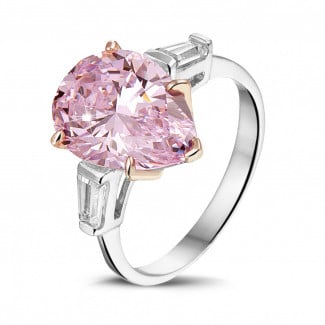
![Ring in white gold with ‘fancy pink‘ pear shaped diamond and taper cut diamonds]() Ring in white gold with ‘fancy pink‘ pear shaped diamond and taper cut diamondsFrom € 2.998.924,50 (incl. 21% VAT)
Ring in white gold with ‘fancy pink‘ pear shaped diamond and taper cut diamondsFrom € 2.998.924,50 (incl. 21% VAT) -
![1.00 carat solitaire ring in white gold with round diamond]() Bestseller1.00 carat solitaire ring in white gold with round diamondFrom € 4.259,20 (incl. 21% VAT)
Bestseller1.00 carat solitaire ring in white gold with round diamondFrom € 4.259,20 (incl. 21% VAT) -
![1.00 carat solitaire diamond ring in white gold with side diamonds]() Bestseller1.00 carat solitaire diamond ring in white gold with side diamondsFrom € 3.968,80 (incl. 21% VAT)
Bestseller1.00 carat solitaire diamond ring in white gold with side diamondsFrom € 3.968,80 (incl. 21% VAT) -
![1.00 carat solitaire stackable ring in white gold with a round diamond with marquise design]() 1.00 carat solitaire stackable ring in white gold with a round diamond with marquise designFrom € 4.380,20 (incl. 21% VAT)
1.00 carat solitaire stackable ring in white gold with a round diamond with marquise designFrom € 4.380,20 (incl. 21% VAT) -
![1.00 carat solitaire ring (half set) in white gold with side diamonds]() Bestseller1.00 carat solitaire ring (half set) in white gold with side diamondsFrom € 5.916,90 (incl. 21% VAT)
Bestseller1.00 carat solitaire ring (half set) in white gold with side diamondsFrom € 5.916,90 (incl. 21% VAT)

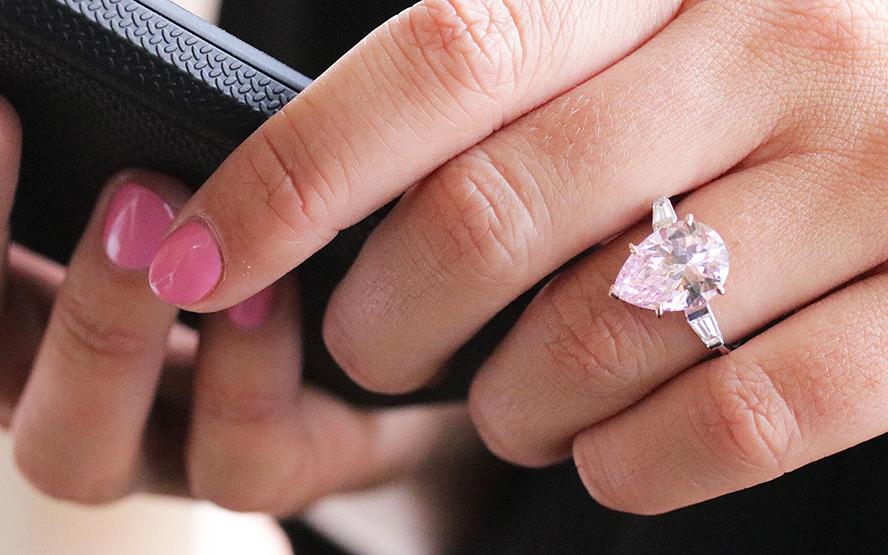
How to verify a natural pink diamond: certificates and lab reports
How to verify a natural pink diamond: certificates and lab reports
When buying a pink diamond remotely, the laboratory report is the most reliable way to confirm origin, treatment status and key quality notes. Reputable reports come from established laboratories and use wording that affects value. Use the checks below before committing to a purchase.
Which certificates to trust
- GIA (Gemological Institute of America): widely accepted for impartial grading. A GIA report for a natural fancy pink will use phrasing such as "Natural Colour, Fancy (Light/Intense/Vivid) Pink" or similar, which indicates both colour grade and that the colour is natural. GIA also records any detected treatments.
- IGI and HRD: internationally recognised labs that issue full reports including colour grade, clarity and notations about treatments or enhancements. They are commonly used in trade and retail.
- Argyle provenance statements: pinks sourced from the Argyle Mine often carried separate provenance paperwork. An Argyle provenance note is a historic document that sits alongside a grading report and supports origin claims.
Key phrases to watch for (and what they mean)
- "Natural Fancy Pink" or "Natural Colour, Fancy Pink": signals the hue is natural rather than the result of treatment. This wording supports market value.
- "Treated", "Colour treated" or similar: indicates the colour was enhanced and the stone should be priced and described as an enhanced diamond.
- "HPHT" or "CVD": these terms point to high-pressure, high-temperature or chemical vapour deposition processes used to alter or create stones. If the report states "lab-grown" or similar, the diamond is synthetic and must be represented as such.
Practical buyer checklist
- Request a full, high-resolution PDF of the laboratory report before purchase; a short summary is not enough.
- Confirm the certificate issuer and check that the report number matches any girdle inscription shown in photos.
- Check the report for treatment notations. If terms such as "Treated", "Irradiated" or "HPHT" appear, treat the stone as enhanced and compare pricing accordingly.
- Ask for provenance or chain-of-custody paperwork for Argyle-origin stones. Genuine Argyle provenance is usually separate from the grading report and should be provided when claimed.
- If uncertainty remains, arrange independent verification from an accredited laboratory before completing a high-value purchase.
Example note
A report that reads "Natural Colour: Fancy Intense Pink" with no treatment notation indicates a natural pink. A report that states "Colour treated: HPHT" or simply "Treated" denotes a colour-enhanced diamond and should be valued accordingly.
Notes on Argyle provenance
Argyle pinks have special market recognition because many high-quality natural pinks from the mine carried specific provenance paperwork. When a seller claims Argyle origin, request the provenance documentation and verify the report number and any laser inscription against that paperwork.
How did pink diamonds come about?
Traditionally, the colour pink has been associated with innocence, sweetness and love. During Queen Elizabeth I's reign in England (1558-1603), pink was thought to bring luck and pleasure.
The value and advantages of a pink diamond
Pink diamonds are subtle in colour and are a beautiful alternative to colourless diamonds. They are easy to combine with other ring types, such a halo ringor a solitaire ring.
Market value, famous sales and what to expect to pay
Pink diamonds sit in a market where rarity and collector demand push prices sharply for the finest stones. A few headline auction results show how premiums develop and help set realistic expectations.
Notable auction sales
- Pink Star (sold 2017): this Fancy Vivid Pink oval of 59.60 carats achieved a record hammer price, illustrating the extreme premiums paid for top-grade, large pinks.
- Graff Pink (sold 2010): the Graff Pink, a Fancy Intense Pink, fetched a very high price at Sotheby's in 2010, showing sustained collector appetite for museum-quality stones.
- Princie Diamond (sold 2013): historically important pinks such as the Princie have also commanded premiums when presented with strong provenance, colour and clarity.
Indicative price bands (illustrative only)
To orient buyers without stating fixed prices, these broad bands reflect common market behaviour rather than guaranteed values:
- 0.50–1.00 ct, Fancy Light to Fancy: generally the most accessible natural pinks for buyers who want a wearable pink without major collector premiums.
- 1.00–2.00 ct, Fancy to Fancy Intense: these sizes and intensities represent a marked step-up in rarity and price sensitivity, especially as saturation improves.
- 2.00+ ct, Fancy Intense to Fancy Vivid: stones in this range with strong saturation and a pleasing secondary tone are uncommon and attract significant interest at auction.
Label: indicative only - actual value depends on intensity, hue, secondary tone and clarity.
What drives price most
Colour intensity is the primary driver: a Fancy Vivid or Fancy Intense pink typically commands a much larger premium than a Fancy Light example of the same carat weight. After intensity, carat weight and secondary tone (for example purplish-pink versus brownish-pink) strongly affect value. Documented provenance or a named history, such as confirmed Argyle origin, can add a further premium.
Market dynamics to consider
The Argyle Mine closure in 2020 removed a main historic source of many pinks, tightening supply and increasing interest in natural pinks. Rarity causes price volatility: the very top stones are highly liquid among collectors, while smaller, less saturated stones have a narrower buyer pool. Anyone considering a pink diamond as an investment should be aware that liquidity varies with size and intensity.
Investment vs personal purchase
If the priority is wear and appearance, focus on colour intensity and a setting that shows the hue. If considering an investment, provenance, intensity and auction record matter more than raw carat weight alone.
Practical buying tip
When comparing stones, prioritise identical certificates and similar intensity grades rather than carat weight alone. Two stones of the same carat can differ greatly in price if one is Fancy Vivid and the other Fancy Light.
The most renowned pink diamonds in the world


Which precious metal should I combine a pink diamond with?
For those among us who love to wear earrings and love the colour pink, a pair of diamond earringsis always a way forward. A diamond necklacewith a diamond in this colour, possibly combined with colourless diamonds, draws the eye without fail.
Simplicity is the golden rule when choosing jewellery with a coloured diamond.

Shape, setting and protective-setting guidance for pink diamonds
Some cuts and settings make pink colour more visible than others. Choosing well starts with the stone shape and continues through the mounting and metal choice.
Which shapes show pink best
Elongated fancy shapes such as oval, cushion and radiant tend to concentrate colour and can display pink tones more vividly than a round, provided proportions are balanced. Cushion cuts with slightly deeper pavilion angles often hold and show colour well. Very elongated ovals or long navettes can stretch the colour and make it look weaker; aim for length-to-width ratios that keep the hue visible.
Round brilliants maximise sparkle but may disperse colour more than fancy shapes. If colour is the priority, pick a shape that preserves saturation rather than one focused only on light return.
Protective and lifestyle-minded settings
Active wearers should consider protective settings. A full or partial bezel surrounds the girdle and reduces the chance of knocks to the crown or culet. Halo settings add a visual frame and can help protect the centre stone's girdle. Four- or six-prong settings lift the diamond for light performance but expose the stone to more direct impact.
Design suggestions by lifestyle
- Daily wear / active lifestyles: choose bezel or low-profile halo settings to reduce snagging and shield the stone.
- Formal or occasional wear: open prong settings showcase the pink colour and allow more light to interact with the diamond.
Cost-conscious design approaches
If budget is a concern, design strategies can preserve the pink look without one large stone. Cluster settings group smaller pinks, or mix small pink accents with colourless melee to create a strong visual pink effect. Using a warmer metal such as rose gold subtly enhances perceived warmth in softer pinks, while platinum or white gold keeps a cooler, more neutral look.
Do / Don't quick guide
- Do choose cushion, radiant or oval cuts when you want stronger colour presence.
- Don't pick an excessively elongated shape if you want maximum saturation; length can dilute tone.
- Do prefer bezel or halo for everyday protection.
- Don't use very high, exposed prongs if you need a secure, low-maintenance ring.
Styling notes
Rose gold settings tend to harmonise with pink diamonds and can make softer pinks appear warmer. Platinum or white gold preserves a cooler presentation. Consider skin tone and wardrobe: warmer metals and clothing palettes enhance pink tones, while cooler metals emphasise contrast and brightness.
Is pink diamond a suitable precious stone in an engagement ring?
Should I choose a pink diamond solitaire or halo engagement ring?
With a halo ring the centre diamond appears bigger than it is, surrounded by smaller diamonds.
Tailor made pink diamond jewellery at BAUNAT

Read more about diamonds
Frequently asked Questions
What is a pink diamond?
A naturally coloured pink diamond is one of the most desirable diamond colours because of its romantic and unique appearance. Fancy pink diamonds are very rare, actually only 0,01% of all diamond carats mined are quality pink stones. Most of the world’s natural pink diamonds were found in the Argyle Mine in Western Australia which was closed in 2020. You can buy pink diamonds with ease at BAUNAT.
Are diamonds rare?
Diamonds are actually quite rare. Also it is true that the process of extracting diamond is quite laborious (mines move many tons of dirt per carat of diamond found) and that gem-quality diamonds are relatively few (only about 1 in 1 million diamonds are quality one carat stones, only 1 in 5 million are 2-carat; and 1 in 15 million are 3-carat).
The prices of diamonds increase along with the inflation rate. In some periods, the demand is higher than the supply whilst in other periods this is reversed. In the end, there is always a balance.
Good to know
What is the earliest record of a man giving a diamond to a woman for her hand in marriage?
In 1477, the Archduke of Austria gave a diamond to Mary of Burgundy. Today, some 500 years later, diamonds are the most popular gemstones in engagement rings.
On average, how old is a diamond?
Diamonds are formed over a period of millions of years deep within earth's crust – about 150km (90 miles) deep. Within time, they are pushed to the surface by volcanoes. Most diamonds are found in volcanic rock, called Kimberlite, or in the sea after having been carried away by rivers when they were pushed to the surface.
A diamond is 58 times harder than corundum, the next hardest mineral on earth, out of which rubies and sapphires are formed. Only in the 15th century, it was discovered that the only way to cut diamonds was with other diamonds.
What is the largest diamond in the world?
The world’s largest diamond known to men was the Cullinan, which was found in South Africa in 1905. Uncut, it weighed 3,106.75 carats. The Cullinan was cut into the Great Star of Africa (530.2 carats), the Lesser Star of Africa (317.40 carats), and an additional 104 other diamonds of nearly flawless colour and clarity. Today, these diamonds form part of the British crown jewels.
The Cullinan was three times the size of the next largest diamond, the Excelsior, which was also found in South Africa. The world’s largest documented polished diamond, which was unearthed in 1986 in South Africa, is called the The Golden Jubilee. It was cut down from a 700 carat rough diamond and weighs 545 carats. The diamond took almost 3 years to cut, just like the Centenary Diamond, which also forms a part of the British crown jewels. This last one weighs 273.85 carats and is considered the world’s largest flawless diamond.
The biggest diamond in the entire universe is thought to be Lucy, a crystallized white dwarf star. It is actually a burned out star from diamonds. It was discovered about 50 light-years away from Earth in the region of the sky we refer to as the constellation Centaurus. Its weight is 10 billion trillion carat. Named after the Beatles song, Lucy in the Sky with Diamonds, the star is technically known as BPM 37093.
In ancient times, what "powers" did people believe diamonds gave them?
In ancient times, diamonds were believed to promote strength, invincibility and courage.
More Diamond Facts
- To produce a single one-carat diamond, 250 tons of earth will be mined.
- Gem-quality diamonds are made up from less than 20 % of the diamonds that are mined worldwide.
- The first written notation of precious diamonds dates back to around 500 B.C.
- In their purest state, diamonds are brilliant and entirely colourless.
- Diamonds are found in a variety of colours. Blue and pink diamonds are the rarest, and yellow and brown are the most common.
- The diamond is rock hard and virtually fireproof. In order for a diamond to burn, it must be heated to 1292 degrees Fahrenheit.
- Out of one-thousand polished diamonds, only one will weigh more than one carat.
- Although the United States of America accounts for less than 1% of total global gemstone productions, they buy more than half of the world's total gem quality diamonds and thus account for the world's largest diamond market.
- Australia produces the most diamonds in volume.
- The Crater of Diamonds State Park in Arkansas is the world’s only diamond mine that is open to the public. Since 1906, more than 70000 diamonds have been discovered in the Crater of Diamonds State Park, including the 40.23 carat Uncle Sam Diamond, which is the largest diamond of its kind ever found in the U.S.A.
-
Kim Wouters
-
BAUNAT Antwerp
-
-
Kim, BAUNAT-certified is quite the Jill of all trades. After being submerged into all aspects of the brand, and being responsible for customer success, order & sales, office management, product management, she has become an expert in everything diamond and jewellery related. Apart from this product expertise, Kim’s master’s degree in communications makes her an excellent Diamond Jewellery Advisor to help you discover your personal taste and make sure all your expectations are exceeded.
Kim, BAUNAT-certified is quite the Jill of all trades. After being submerged into all aspects of the brand, and being responsible for customer success, order & sales, office management, product management, she has become an expert in everything diamond and jewellery related. Apart from this product expertise, Kim’s master’s degree in communications makes her an excellent Diamond Jewellery Advisor to help you discover your personal taste and make sure all your expectations are exceeded.