







Features:
-
Category:
-
Posted at:
-
Author:
- Fabienne Rauw
-
BAUNAT Antwerp
-


-
Reading time:13 minutes
In this article:
- So, what exactly is ethical jewellery?
- Quick checklist: What to ask when buying ethical jewellery
- Understanding the origin of diamonds
- Exploring the mining process
- How to verify certifications and traceability
- Diamond mining involves significant funds, tools, manpower, and time. Prominent extraction methods include deep mine shafts and vast corridor systems or underwater procedures. BAUNAT ensures it purchases its diamonds right from the source, maintaining ful
- Understanding Jewellery Production
- Material-by-material: what to choose and why
- Choosing Ethical Jewellery from BAUNAT
- What else should you consider about jewellery collections?
Discover Your Sparkle: A Guide to Purchasing Ethical Jewelry
Your trust is the cornerstone upon which the successful jewellery industry stands today. If you aspire to expand your jewellery collection, you're seeking pieces of remarkable value, irresistibly emotional appeal, and exceptional quality. Hence, a thoroughly inspected production chain becomes imperative for garnering and retaining this trust.
Read summary
How can you ensure your jewelry purchase is ethical?
When investing in precious jewelry, understanding the ethical sourcing and production process is crucial. Ethical jewelry features full transparency throughout its production chain—from raw material extraction to the finished piece.
BAUNAT emphasizes several key factors in ethical diamond purchasing: quality information about stones, certificates from recognized laboratories, details about production locations, and thorough vetting of the entire supply chain.
Diamond mining involves complex processes with significant resources. Unfortunately, some diamonds from conflict regions (known as "blood diamonds") have funded rebel groups, prompting the UN to implement certification systems to prevent their trade.
BAUNAT addresses ethical concerns by purchasing diamonds directly from responsible sources and crafting jewelry by hand in their Antwerp studios. This approach ensures they maintain control over the entire production process, avoiding exploitation and child labor issues that can occur with outsourced manufacturing.
By choosing ethical jewelry, you invest in pieces that are not only beautiful but also responsibly sourced.
5 Questions to Find Her Perfect Engagement Ring
Are you planning to propose? Finding the right engagement ring is a defining step. Every ring is handcrafted in Antwerp from the finest materials by skilled artisans. Discover what engagement ring fits her personality.
Most viewed diamond jewels
-
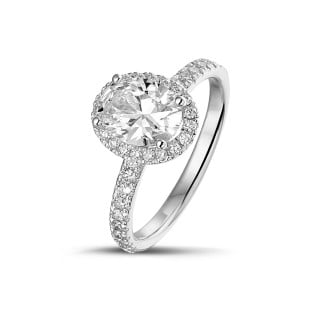
![1.00Ct halo ring in white gold with oval diamond]() Bestseller1.00Ct halo ring in white gold with oval diamondFrom € 5.578,10 (incl. 21% VAT)
Bestseller1.00Ct halo ring in white gold with oval diamondFrom € 5.578,10 (incl. 21% VAT) -
![1.00 carat solitaire cluster ring in white gold with marquise diamond]() BestsellerNew1.00 carat solitaire cluster ring in white gold with marquise diamondFrom € 4.622,20 (incl. 21% VAT)
BestsellerNew1.00 carat solitaire cluster ring in white gold with marquise diamondFrom € 4.622,20 (incl. 21% VAT) -
![0.95 carat diamond rose design ring in white gold]() NewPrincess Delphine0.95 carat diamond rose design ring in white goldFrom € 16.831,10 (incl. 21% VAT)
NewPrincess Delphine0.95 carat diamond rose design ring in white goldFrom € 16.831,10 (incl. 21% VAT) -
![1.00 carat solitaire ring with an asscher cut diamond in white gold]() Bestseller1.00 carat solitaire ring with an asscher cut diamond in white goldFrom € 4.936,80 (incl. 21% VAT)
Bestseller1.00 carat solitaire ring with an asscher cut diamond in white goldFrom € 4.936,80 (incl. 21% VAT) -
![1.00 carat solitaire ring with a cushion diamond and hidden halo in white gold]() BestsellerNew1.00 carat solitaire ring with a cushion diamond and hidden halo in white goldFrom € 4.210,80 (incl. 21% VAT)
BestsellerNew1.00 carat solitaire ring with a cushion diamond and hidden halo in white goldFrom € 4.210,80 (incl. 21% VAT)


So, what exactly is ethical jewellery?
• Quality information about the precious stones
• Certificates from recognized laboratories
• Details about who produces the jewellery and where- locally or abroad
• Chain of production and if the process is effectively vetted by the company
These information pieces are paramount when you buy diamonds, whether for wearing or as a form of smart investment.
Quick checklist: What to ask when buying ethical jewellery
When you speak with a seller or view a piece in person, these concise questions help verify provenance and production standards. Ask them directly and expect specific answers.
- Is there a certificate for this stone? - Ask for the type of certificate and the issuing laboratory or authority, not just a handwritten note.
- Do you have documentation for the metal (recycled or verified supply)? - Sellers should be able to state whether metals are recycled or come with supplier attestations.
- Has the piece been independently inspected or graded? - Independent grading or appraisals add confidence beyond the seller’s claim.
- Who made the piece and where was it manufactured? - Knowing whether production was local and handcrafted or outsourced clarifies labour and ethical practices.
- What warranty or aftercare do you offer? - Ethical purchase includes transparent consumer protections and clear information on repairs and maintenance.
- If the stone is lab-grown, how was it produced? - Ask for a plain explanation of the process and any energy or sourcing claims the seller makes.
- Can you provide a PDF of the certificate or origin report now? - Requesting a digital copy makes it easier to verify later.
These questions are quick to use in-store, over email, or on the phone. When BAUNAT presents a piece, we ensure answers are specific and supported by documentation, so you can buy with confidence.

Understanding the origin of diamonds
Exploring the mining process
Diamond mines are generally controlled by large industrial corporations, thus escalating the risk of exploitation and fostering the notorious term 'blood diamond.' These diamonds originate from African conflict regions, and their sales proceeds aid rebel groups. Pursuant to the United Nations' request, a certification system was introduced to curb trading these diamonds.
How to verify certifications and traceability
Not all certificates and provenance claims carry the same weight. Use the steps below to judge legitimacy and spot weak or misleading statements.
Common certifications and what they indicate
- Kimberley Process - Confirms a diamond was not sold to finance armed conflict, but it does not guarantee broader social or environmental standards.
- GIA / HRD (grading reports) - Provide independent assessment of cut, color, clarity and carat for diamonds; use the report number to verify with the lab.
- Responsible Jewellery Council (RJC) - A standards and chain-of-custody framework for members; membership suggests system-level controls but check for recent audit dates.
- Fairmined / Fairtrade Gold - Standards that address mining community benefits and traceability for gold; certificates normally list mine or cooperative details.
- Independent origin reports (Diamond Origin Report or provenance statements) - May show the route a stone took from mine to market; legitimacy depends on the issuing body and level of detail.
Documents to request
- Full laboratory grading report with report number and issuer name (PDF preferred).
Simple checks for basic legitimacy
- Match certificate IDs with the issuing body's online verification tool.
- Ask the seller to share a PDF and then call or email the issuing laboratory to confirm authenticity if anything seems unclear.
- Check dates and visible issuer stamps or signatures; an expired or undated certificate is a red flag.
Red flags to watch for
- No paperwork offered
- Certificates without issuer details, serial numbers or contactable references.
If a seller hesitates to provide these documents, treat that as cause for additional scrutiny. BAUNAT provides documented certificates and provenance information so customers can independently verify the claims accompanying each piece.
Diamond mining involves significant funds, tools, manpower, and time. Prominent extraction methods include deep mine shafts and vast corridor systems or underwater procedures. BAUNAT ensures it purchases its diamonds right from the source, maintaining ful

Understanding Jewellery Production
Looking for a bespoke jewellery piece? Check out our style guide or commission a custom-made piece. With BAUNAT, the creation process follows dedicated steps:
• Choice of material and precious stones
• Rough sketch of the design
• 3-D digital visualization of the jewellery
• Traditional, handcrafted jewellery
• Rigorous quality control by our in-house experts
Material-by-material: what to choose and why
When choosing ethical jewellery, the material matters for environmental impact, resale expectations and maintenance. Below is a concise, practical comparison to help you decide.
Recycled metals
Pros: Lowers demand for new mining, reduces extraction-related impacts, and often carries supplier attestations.
Cons: Recycled content can vary; ask for supplier certificates to confirm recycled percentages.
What to ask: Request a recycled metals certificate or supplier attestation and details on alloy composition.
BAUNAT stance: We prioritise verified recycled metal sources when requested and can provide supplier documentation on request.
Lab-grown diamonds
Pros: Chemically identical to natural diamonds, typically have a smaller supply-chain footprint, and are available in consistent qualities.
Cons: Market resale and long-term value differ from natural stones; energy usage varies by production method and should be assessed case-by-case.
What to ask: Ask whether the stone is CVD or HPHT grown, for a grading report, and for any statements about energy sourcing.
BAUNAT stance: Lab-grown diamonds are an alternative with clear trade-offs; we provide transparent grading and origin information so you can compare responsibly.
Responsibly mined diamonds
Pros: Natural rarity and established resale market; when properly traced, support for mining communities can be demonstrated.
Cons: Mining has higher inherent environmental impacts; responsible sourcing requires independent verification and traceability.
What to ask: Request a provenance report, grading certificate, and details on the chain of custody from mine to retailer.
BAUNAT stance: We purchase directly from sources and maintain documentation to ensure traceability and ethical procurement practices.
Colored gemstones
Pros: Wide range of ethical sourcing options exists, from small-scale artisanal mines with community benefits to certified supply chains.
Cons: Traceability for some colored stones can be harder to demonstrate; treatments and enhancements affect value and care.
What to ask: Ask for treatment disclosures, origin statements, and any laboratory reports available.
BAUNAT stance: For coloured gemstones we provide treatment and origin information where available, and insist on transparent disclosure.
Quick practical note on resale and value
Natural diamonds typically have established secondary markets; lab-grown stones may behave differently in resale. If long-term financial value is a priority, request market guidance and documentation to support future valuation.
Choosing between recycled metals, lab-grown or responsibly mined stones depends on your priorities: environmental footprint, traceability, or market value. Clear documentation and independent grading are essential across all choices.
Choosing Ethical Jewellery from BAUNAT
• We directly purchase diamonds from the source and continually offer accredited certificates for certified diamonds.
• We design and produce jewellery by hand at our local Antwerp studio. This way, we ensure that we maintain control over the entire production chain of all our diamonds and jewellery.

What else should you consider about jewellery collections?
Remember the adage, 'Diamonds are forever'? With BAUNAT, we ensure they are also ethically sourced, magnificently crafted, and a smart investment.