







Features:
-
Category:
-
Posted at:
-
Author:
- Fabienne Rauw
-
BAUNAT Antwerp
-


-
Reading time:11 minutes
In this article:
- A Brief History of Hallmarks in Jewellery
- Where to find the hallmark on your jewellery
- Hallmarks: Indicating Purity and Provenance
- What a hallmark shows: the four common elements
- Hallmarking, a Tradition Dating Back Centuries
- How BAUNAT Marks Your Jewellery
- Can a hallmark be forged? What to do if you’re unsure
Unveiling the Natural Beauty: BAUNAT’s Approach to Hallmarked Jewellery
At BAUNAT, we understand the significance of hallmarks in the world of precious metals and jewellery - they are more than mere symbols. Rooted in a rich history of authenticity and quality control, hallmarks are a testament to the superior quality we offer - that’s why each of our handcrafted pieces tells a unique story through its hallmark.
Read summary
What makes hallmarked jewelry a mark of authenticity and quality?
Hallmarks in jewelry serve as crucial quality indicators, revealing the purity and provenance of precious metals. At BAUNAT, these small imprints tell a significant story about each handcrafted piece. Dating back to 13th century England when King Henry III established regulations for precious metals, hallmarking has evolved into a global standard that protects consumers from fraudulent practices.
Each hallmark indicates the ratio of pure metal to alloy, providing assurance of legitimacy in a world where metals are often mixed for durability. BAUNAT employs both traditional struck marks, applied with hammer and punch, and modern laser etchings to ensure every gold, platinum, palladium, or silver piece meets strict quality standards.
As Belgian designers based in Antwerp's diamond district, BAUNAT's commitment to quality shines through these hallmarks, each one representing their dedication to unveiling natural beauty.
Most viewed diamond jewels
-
![1.00Ct halo ring in white gold with oval diamond]() Bestseller1.00Ct halo ring in white gold with oval diamondFrom € 5.578,10 (incl. 21% VAT)
Bestseller1.00Ct halo ring in white gold with oval diamondFrom € 5.578,10 (incl. 21% VAT) -
![1.00 carat solitaire cluster ring in white gold with marquise diamond]() BestsellerNew1.00 carat solitaire cluster ring in white gold with marquise diamondFrom € 4.622,20 (incl. 21% VAT)
BestsellerNew1.00 carat solitaire cluster ring in white gold with marquise diamondFrom € 4.622,20 (incl. 21% VAT) -
![0.95 carat diamond rose design ring in white gold]() NewPrincess Delphine0.95 carat diamond rose design ring in white goldFrom € 16.831,10 (incl. 21% VAT)
NewPrincess Delphine0.95 carat diamond rose design ring in white goldFrom € 16.831,10 (incl. 21% VAT) -
![1.00 carat solitaire ring with an asscher cut diamond in white gold]() Bestseller1.00 carat solitaire ring with an asscher cut diamond in white goldFrom € 4.936,80 (incl. 21% VAT)
Bestseller1.00 carat solitaire ring with an asscher cut diamond in white goldFrom € 4.936,80 (incl. 21% VAT) -
![1.00 carat solitaire ring with a cushion diamond and hidden halo in white gold]() BestsellerNew1.00 carat solitaire ring with a cushion diamond and hidden halo in white goldFrom € 4.210,80 (incl. 21% VAT)
BestsellerNew1.00 carat solitaire ring with a cushion diamond and hidden halo in white goldFrom € 4.210,80 (incl. 21% VAT)


A Brief History of Hallmarks in Jewellery
Hallmarking, originating from the UK's Goldsmiths’ Company Assay Office, was devised as a regulatory measure to maintain the purity of gold and silver wares. This was done to prevent fraudulent activities by goldsmiths and jewellers. Through time, hallmarking has evolved into a universal standard, allowing us at BAUNAT to deliver pristine quality natural diamonds, personally serviced for your satisfaction.
Where to find the hallmark on your jewellery
Hallmarks are usually small and placed where they stay protected yet remain readable. Use good light and, if available, a loupe; slowly rotate the piece to catch tiny reliefs or laser etching. Typical locations by item type:
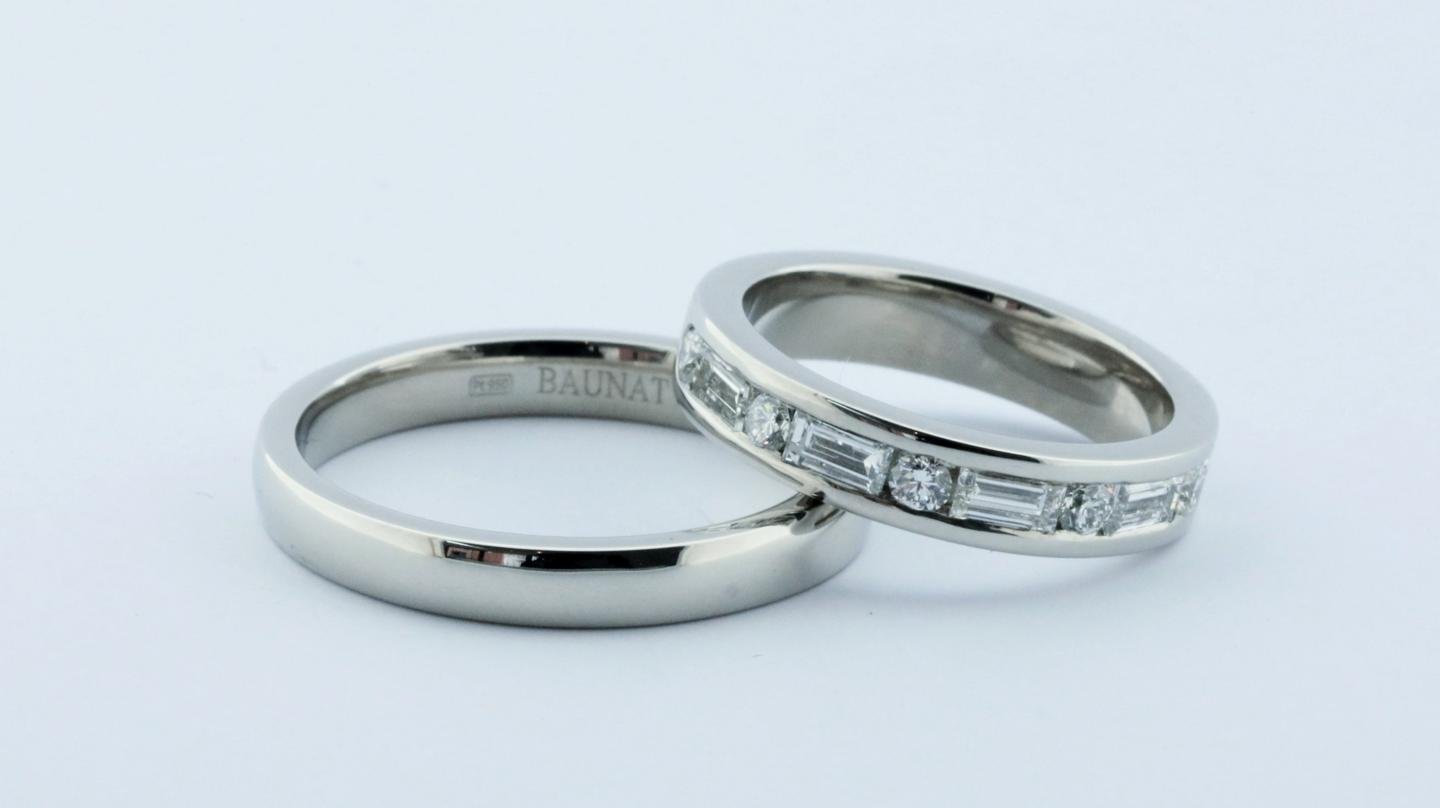
- Rings: on the inside of the band, often near the shoulder or opposite the setting. For comfort-fit bands the mark can be nearer the centre of the interior surface.
- Pendants and lockets: on the back plate or inside the bail where the chain passes through. Small pendants sometimes carry only a tiny laser mark on an internal surface.
- Bracelets and chains: beside or on the clasp, often on the jump ring close to the fastener.
- Earrings: on the post, the backplate, or the flat surface behind a stud; hoop earrings may have a mark on the inside curve.
- Watches and larger pieces: on the case back or inside the case where movement or fittings allow.
Quick inspection tips
Work in strong light and rest the piece on a soft surface to avoid scratches. If a mark is hard to see, a jeweller’s loupe, a smartphone camera with macro mode, or a hand-held magnifier will usually reveal tiny stamping or laser engraving. Designer or maker marks are often very small, so a careful, patient inspection pays off.
Hallmarks: Indicating Purity and Provenance
A hallmark is essentially a quality seal that indicates the ratio of pure metal to alloy in a precious piece. In a world where precious metals are frequently mixed with other elements for enhanced durability and workability, hallmarks reassure you of the legitimacy and quality of the metal in your jewellery.
At BAUNAT, we carefully inscribe hallmarks onto our range of gold, platinum, palladium and silver jewellery, not only guaranteeing the jewellery's purity but also its provenance.
What a hallmark shows: the four common elements
A full hallmark is a compact record of who made a piece, what the metal is, where an independent test was done, and when that test took place. Reading these four elements makes the tiny marks on your jewellery easier to understand and gives clear information about the piece.
Sponsor’s or maker’s mark
This is the maker’s identifier, usually initials or a small registered symbol. It links the piece to the workshop or company that placed it on the market. For example, a maker could use initials such as BAU or a small logo registered with the local assay authority.
Millesimal fineness (standard) mark
This number shows how many parts out of 1,000 are pure metal and is the standard way to state metal purity. Typical examples you will see are:
- 925 - sterling silver (925 parts pure silver per 1,000)
- 750 - 18 carat gold (750 parts pure gold per 1,000)
- 585 - 14 carat gold (585 parts pure gold per 1,000)
- 950 - platinum (950 parts pure platinum per 1,000)
These figures are concise; when you spot them they tell you the metal’s minimum guaranteed purity.
Assay office mark
This symbol indicates which independent assay office tested and verified the metal. Each office has its own emblem, so the mark identifies where the piece was examined rather than who made it. Seeing the assay office mark confirms an independent check took place.
Date letter
A small letter, often set in a shaped cartouche, corresponds to the year of assay. Together with the other marks it allows precise dating of when the item was verified.
How to read a typical set
A conventional hallmark often combines a maker’s mark, a fineness number such as 750, an assay office emblem, and a date letter. You may also see abbreviations like PT or PLAT for platinum, or simple numeric values such as 925 for silver. Read marks left to right where possible: maker, fineness, assay office, date.
At BAUNAT we apply hallmarking so each element is meaningful: the maker’s mark connects the piece to our workshop, the fineness number confirms material integrity
Hallmarking, a Tradition Dating Back Centuries
The tradition of hallmarking traces back to the late 13th century when King Henry III of England took steps to regulate precious metals. He ordered the City of London to appoint the top six goldsmiths to inspect the craft, who eventually became the Guardians of the craft, bestowing upon pieces the mark of the city - a leopard’s head.
How BAUNAT Marks Your Jewellery
We craft your jewellery with utmost precision, incorporating both traditional and modern marking techniques. The traditional struck mark is imprinted with a punch and hammer, ideally on the unfinished piece, ensuring it withstands the final finishing and lasts a lifetime.
The laser mark, a modern technique driven by technological advancements, serves ideally for finished and polished pieces. A high-powered laser beam etches the hallmarks on the metal, without compromising the piece’s design or integrity.
At BAUNAT, we're more than just fine jewellery creators. We're a team of passionate Belgian designers situated in the heart of the diamond district in Antwerp, committed to creating unique pieces of jewellery that carry a piece of history with them. We recognize the beauty of natural diamonds and strive to unveil that beauty for you, one hallmark at a time.
The art of hallmarking demonstrates our commitment to quality, provenance, and excellence, perfectly encapsulating our love for natural diamond jewellery. It's not just about creating jewellery; it's about unveiling natural beauty.
Can a hallmark be forged? What to do if you’re unsure
Hallmarks can be tampered with or imitated, so a cautious eye is sensible when authenticity matters. Red flags include inconsistent typefaces or depths in a series of marks, marks that appear misaligned or poorly struck, and abbreviations or symbols that do not match known assay office emblems. If a mark looks irregular or seems newly added to an otherwise worn surface, seek professional verification.
-
Fabienne Rauw
-
BAUNAT Antwerp
-
-
Fabienne, manager of the German market is able to guide every client with finding the right jewel. She takes care of most of the German orders, but also takes other task on her plate. Thanks to her six years of experience at BAUNAT she acquainted well with the product and the marketing around it. Her degree in PR ensures that BAUNAT is well presented across all media channels. For anyone looking into a new investment opportunity, Fabienne is the perfect guide in this process. No question will be left unanswered, and she will help you every step of the way.
Selected Bespoke Projects
• Eternal Bloom bespoke engagement concept - Role: project lead for client briefing and prototype coordination. Fabienne translated personal design references into a 3D-printed prototype, supervised stone selection and ensured the finished piece matched the client’s vision and comfort preferences.
• Personalized anniversary necklace - Role: design coordinator and quality overseer. She managed the custom design process from the initial sketch to final polishing, liaising between client and workshop to preserve proportions and finish.
• Reimagined heirloom ring restoration and redesign - Role: client consultant and technical coordinator. Fabienne guided the client through options to modernize setting details while keeping sentimental elements, delivering a wearable result that respected the original piece.
Her hands-on involvement in bespoke commissions ensures each custom order has a clear brief, careful prototype review and close follow-up with the workshop, so clients receive a tailored jewel that meets both aesthetic and practical expectations.
Professional enquiries
For speaking engagements, press requests or research collaborations, please send your message to BAUNAT’s communications team with the subject line: "Fabienne Rauw - Professional Enquiry." Include a brief description of the request and any relevant dates or documents. The communications team will route enquiries to Fabienne and provide guidance on next steps.
Fabienne, manager of the German market is able to guide every client with finding the right jewel. She takes care of most of the German orders, but also takes other task on her plate. Thanks to her six years of experience at BAUNAT she acquainted well with the product and the marketing around it. Her degree in PR ensures that BAUNAT is well presented across all media channels. For anyone looking into a new investment opportunity, Fabienne is the perfect guide in this process. No question will be left unanswered, and she will help you every step of the way.
Selected Bespoke Projects
• Eternal Bloom bespoke engagement concept - Role: project lead for client briefing and prototype coordination. Fabienne translated personal design references into a 3D-printed prototype, supervised stone selection and ensured the finished piece matched the client’s vision and comfort preferences.
• Personalized anniversary necklace - Role: design coordinator and quality overseer. She managed the custom design process from the initial sketch to final polishing, liaising between client and workshop to preserve proportions and finish.
• Reimagined heirloom ring restoration and redesign - Role: client consultant and technical coordinator. Fabienne guided the client through options to modernize setting details while keeping sentimental elements, delivering a wearable result that respected the original piece.
Her hands-on involvement in bespoke commissions ensures each custom order has a clear brief, careful prototype review and close follow-up with the workshop, so clients receive a tailored jewel that meets both aesthetic and practical expectations.
Professional enquiries
For speaking engagements, press requests or research collaborations, please send your message to BAUNAT’s communications team with the subject line: "Fabienne Rauw - Professional Enquiry." Include a brief description of the request and any relevant dates or documents. The communications team will route enquiries to Fabienne and provide guidance on next steps.